
Freelancing vs Gig Work vs Part-Time Jobs: Which Type of Flexible Work Suits You?
An in-depth comparison of freelancing, gig work, and part-time jobs to help you choose the best fit for your lifestyle.
Freelancing vs Gig Work vs Part-Time Jobs: Which Type of Flexible Work Suits You?
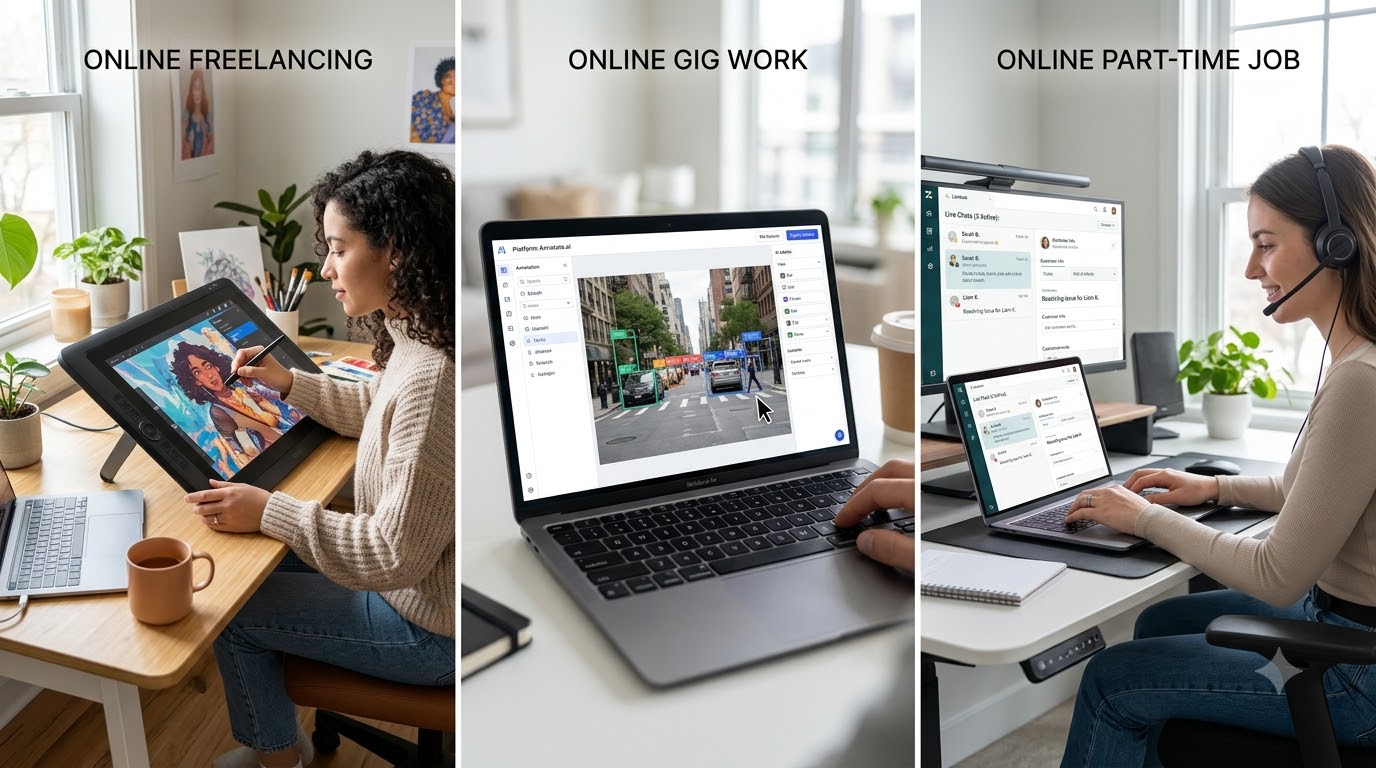
Flexible work is no longer one single category. A student tutoring online, a designer working for three clients, a delivery partner accepting orders through an app, and a retail employee working four hours every evening may all describe themselves as "part-time workers" in casual conversation—but their actual work arrangements are very different.
Understanding those differences matters because income stability, flexibility, skill requirements, expenses, legal status, and growth potential can vary significantly between freelancing, gig work, and part-time employment.
The most important idea is this:
Freelancing usually describes a client-based self-employment relationship. Gig work usually describes short-duration or task-based work outside a traditional employer-employee relationship. Part-time work usually describes employment for fewer hours than a full-time schedule.
These categories can also overlap. A freelance graphic designer can take one-off gigs. A platform worker can work only part-time hours. A part-time employee can freelance on weekends.
So the right question is not simply, "Which category is best?" It is:
Which work model gives you the right balance of flexibility, predictability, skill growth, effort, and earning potential?
Quick Comparison: Freelancing vs Gig Work vs Part-Time Jobs
| Factor | Freelancing | Gig Work | Part-Time Job |
|---|---|---|---|
| Typical relationship | Independent worker and client | Worker and platform/task provider | Employee and employer |
| Work unit | Project, deliverable, hourly work, retainer | Task, trip, visit, order, survey, audit, shift | Scheduled hours or shifts |
| Who finds the work? | Usually you | Usually a platform/provider offers tasks | Employer gives scheduled work |
| Schedule flexibility | High | Very high in many gig models | Medium to low |
| Income predictability | Medium to low initially | Low to medium | Usually higher |
| Skill requirement | Often medium to high | Low to high depending on gig | Depends on role |
| Client acquisition needed | Yes, often | Usually no | No |
| Long-term earning ceiling | Potentially high | Depends heavily on task economics | Usually linked to wage and hours |
| Career portfolio potential | High | Medium | Medium to high |
| Administrative work | High | Low to medium | Low |
| Equipment/expense risk | Often worker-funded | Often partly worker-funded | Often employer-funded |
| Best for | Skill-based independent work | Maximum schedule flexibility | Predictable side income |
Important: This table describes common patterns, not legal rules for every job. Always read the actual contract, offer letter, platform terms, and payment conditions.
Flexible Work in India: The Bigger Picture
India's flexible-work economy is becoming too large to treat as a niche.
NITI Aayog estimated that India had around 77 lakh (7.7 million) gig workers in 2020-21 and projected the gig workforce could reach 2.35 crore (23.5 million) by 2029-30. Under that projection, gig workers would account for roughly 6.7% of India's non-agricultural workforce and around 4.1% of the total workforce by 2029-30.
NITI Aayog also estimated that, at the time of its study, gig work was distributed across skill levels:
- about 47% medium-skilled work,
- about 31% low-skilled work, and
- about 22% high-skilled work.
This is important because gig work is not limited to delivery or driving. It can include sales, business verification, professional services, field audits, digital tasks, technical work, content, design, consulting, and many other activities.
India's broader labour market is also large and fluid. According to the Ministry of Statistics and Programme Implementation's PLFS dashboard, for people aged 15 years and above in July 2026:
- Labour Force Participation Rate (LFPR), current weekly status: 55.4%
- Worker Population Ratio (WPR), current weekly status: 52.5%
- Unemployment Rate (UR), current weekly status: 5.1%
Flexible work therefore sits inside a labour market where millions of people may move between education, employment, self-employment, casual work, household responsibilities, and multiple income sources.
1. What Is Freelancing?
A freelancer independently provides a service to one or more clients instead of working as a regular employee of one organisation.
Common freelance services include:
- graphic design,
- video editing,
- software development,
- website development,
- content writing,
- translation,
- bookkeeping,
- digital marketing,
- social media management,
- photography,
- consulting,
- tutoring,
- UI/UX design,
- virtual assistance,
- SEO,
- data analysis.
A freelancer may charge:
- per hour,
- per day,
- per project,
- per deliverable,
- per word,
- per design,
- per consultation,
- or through a monthly retainer.
Example
Suppose a local restaurant needs:
- a menu redesign,
- 20 product photos,
- Google Business Profile updates,
- and 10 Instagram posts.
A freelancer may quote a package price, complete the work over one or two weeks, submit the deliverables, and invoice the client.
The freelancer is selling a skill and outcome, not simply attendance.
The Biggest Advantage of Freelancing: Earning Leverage
A salaried or hourly worker usually increases income by working more hours, receiving an increment, or getting promoted.
A freelancer has additional levers:
- increase the rate,
- specialise in a higher-value skill,
- complete projects faster,
- sell packages instead of hours,
- retain recurring clients,
- create templates or reusable systems,
- outsource parts of delivery,
- move from execution to consulting.
That gives freelancing a potentially higher ceiling than many basic hourly side jobs.
But the ceiling comes with risk.
A freelancer may have excellent work skills and still struggle because freelancing also requires:
- lead generation,
- pitching,
- negotiation,
- scope management,
- invoicing,
- follow-ups,
- customer service,
- revision control,
- payment collection,
- reputation building.
In other words:
Freelancing is part skill and part small business.
A Better Freelancing Formula
Many beginners think:
Income = Hourly Rate × Hours Worked
A more realistic calculation is:
Net Freelance Income = Client Revenue - Tools - Platform Fees - Marketing - Travel - Outsourcing - Payment Costs - Taxes/Compliance Costs
There is another hidden issue: not every working hour is billable.
You may spend time on:
- finding leads,
- preparing proposals,
- talking to prospects,
- revisions,
- creating invoices,
- learning,
- portfolio updates,
- collecting payments.
So if you spend 60 hours on your freelance business in a month but only 35 hours are billable, your true hourly economics should consider all 60 hours.
Practical trick: Track your effective hourly rate
Use:
Effective Hourly Rate = Net Income ÷ Total Hours Spent
This number is more useful than your advertised hourly rate.
2. What Is Gig Work?
India's Code on Social Security, 2020 defines a gig worker as a person who performs work or participates in a work arrangement and earns from those activities outside a traditional employer-employee relationship.
The Code came into force as part of India's four Labour Codes on 21 November 2025.
Gig work is usually broken into small, clearly defined units of work.
Examples can include:
- delivery,
- rides,
- local business verification,
- mystery shopping,
- store audits,
- photographing a location,
- field surveys,
- lead collection,
- merchant onboarding,
- data collection,
- product testing,
- app testing,
- microtasks,
- event assistance,
- promotional work,
- short-duration professional assignments.
Some gigs are platform-based, meaning an app or website connects workers with tasks. Others may come directly from agencies or businesses.
Gig Work Is Not the Same as Delivery Work
Delivery is simply one highly visible category.
NITI Aayog's analysis found gig work across retail, transportation, manufacturing, finance and insurance, education, professional work, and other sectors.
This means a person can participate in gig work even if they:
- do not own a bike,
- do not want delivery work,
- prefer online tasks,
- prefer field visits,
- have professional skills,
- want only weekend work.
The real defining feature is usually the task-based work arrangement, not the industry.
Why Gig Work Can Be Extremely Flexible
In many gig models, you do not have to spend weeks finding a client.
Instead, the platform or task provider may already have work available.
The workflow can look like this:
- Open the app or platform.
- Check available tasks.
- Read the eligibility and instructions.
- Accept a task.
- Complete it.
- Submit proof or deliverables.
- Wait for verification.
- Receive payment according to the platform's terms.
This removes one of the hardest parts of freelancing: client acquisition.
However, it creates a different risk:
You depend on task availability, task pricing, platform rules, location demand, and approval criteria.
High flexibility does not automatically mean high or predictable income.
3. What Is a Part-Time Job?
A part-time job normally means you are employed for fewer hours than the employer's comparable full-time schedule.
Examples include:
- working 4 hours every evening at a store,
- tutoring at an institute three days a week,
- weekend customer support,
- part-time receptionist work,
- evening data-entry work,
- restaurant shifts,
- retail sales,
- telecalling,
- warehouse support,
- office assistant work.
Unlike many freelancers and gig workers, a part-time employee typically has a more direct employer relationship.
The employer may decide:
- your working hours,
- reporting manager,
- location,
- duties,
- attendance requirements,
- performance process,
- wage cycle.
Important misconception: Part-time does not automatically mean 20 hours per week
You may often see examples such as "20 hours per week," but there is no single universal number that defines every part-time job in India.
One employer may consider 24 hours per week part-time. Another may schedule four-hour shifts. Another may use weekend-only workers.
Always check the actual offer letter, shift schedule, wage structure, and applicable employment rules.
The Most Important Difference: Who Controls the Work?
A useful way to compare the three models is to ask five questions.
1. Who decides when you work?
Freelancer: Usually you, subject to deadlines and meetings.
Gig worker: Often you decide when to accept tasks, although task deadlines, peak-hour incentives, location availability, or service-level rules may reduce flexibility.
Part-time employee: Usually the employer decides the shift.
2. Who decides how much you are paid?
Freelancer: You can quote or negotiate your rate.
Gig worker: The task provider or platform often sets the payment or gives a fixed offer.
Part-time employee: Compensation is agreed as an hourly, daily, weekly, or monthly wage/salary according to the job terms.
3. Who finds the customer?
Freelancer: Usually the freelancer.
Gig worker: Usually the platform, agency, or task provider.
Part-time employee: Customer acquisition is generally the employer's responsibility.
4. Who carries business risk?
Freelancer: High. No clients can mean no revenue.
Gig worker: Medium. There may be no available tasks, or expenses can make low-value gigs unprofitable.
Part-time employee: Usually lower. If you are scheduled and employed, income tends to be more predictable, although job continuity still depends on the employer and contract.
5. Who pays the work expenses?
It depends on the role.
A freelancer may pay for:
- laptop,
- software,
- internet,
- ads,
- subscriptions,
- travel.
A gig worker may pay for:
- fuel,
- mobile data,
- vehicle maintenance,
- parking,
- travel,
- work equipment.
A part-time employer may provide more of the required infrastructure, but this should never be assumed.
Always calculate net income after work-related expenses.
Gross Earnings vs Real Earnings
This is one of the most important flexible-work lessons.
If a gig pays ₹300 but you spend:
- ₹80 on fuel,
- ₹30 on parking,
- ₹20 on mobile/data allocation,
- and 2.5 hours including travel,
your gross earning is ₹300, but your real economics are very different.
Simple net-income calculation
Net Earnings = Gross Payment - Direct Work Expenses
Effective hourly earning
Effective Hourly Earnings = Net Earnings ÷ Total Time
Using the illustrative example above:
₹300 - ₹130 = ₹170 net
If the complete task takes 2.5 hours:
₹170 ÷ 2.5 = ₹68 per hour
That does not mean all ₹300 gigs are bad. A nearby task taking 45 minutes may be attractive.
The lesson is:
Compare gigs by net earnings per hour, not by headline payout.
An Illustrative Comparison
The figures below are examples to show how the maths works. They are not market averages or income promises.
| Scenario | Gross Income | Work Costs | Total Time | Effective Rate |
|---|---|---|---|---|
| Freelancer: ₹8,000 project | ₹8,000 | ₹500 | 20 hours total | ₹375/hour |
| Gig worker: 10 tasks × ₹300 | ₹3,000 | ₹700 | 12 hours total | about ₹192/hour |
| Part-time job: ₹10,000/month | ₹10,000 | ₹1,200 commuting | 80 hours | ₹110/hour |
The point is not that one model always pays more.
The point is that the correct comparison changes after expenses and unpaid time are included.
Flexibility: Which Model Wins?
Freelancing
Flexibility score: High
You can often choose:
- clients,
- projects,
- work location,
- working time,
- rates.
But deadlines can create periods of intense work.
A freelancer with five demanding clients may feel less flexible than a part-time employee with one predictable evening shift.
Gig Work
Flexibility score: Very high for many on-demand gigs
Gig work can be ideal when your free time changes every day.
For example:
- a college student with changing class schedules,
- a homemaker with variable availability,
- an office employee with free weekends,
- someone preparing for competitive exams,
- someone between jobs.
But task availability may not match your availability.
Part-Time Jobs
Flexibility score: Medium
A part-time job sacrifices some freedom in exchange for predictability.
You may need to work:
- every evening from 6 PM to 10 PM,
- every Saturday and Sunday,
- specific rotating shifts.
If you can commit to those hours, this can be easier to plan financially.
Income Stability: Which Model Wins?
Most predictable: Part-time employment
If the employer provides fixed shifts and regular wages, you have a better idea of what you may earn each month.
Middle: Established freelancing
A beginner freelancer can have irregular income.
But a freelancer with three monthly retainer clients can become surprisingly stable.
For example:
- Client A: monthly social media package
- Client B: monthly website maintenance
- Client C: monthly design support
This can produce more predictable revenue than constantly chasing one-off projects.
Most variable: On-demand gig work
A gig worker's income may change because of:
- task supply,
- demand,
- city,
- season,
- platform pricing,
- incentives,
- weather,
- competition,
- qualification,
- approval rates.
That is why gig income should initially be treated as variable income, not guaranteed salary.
Skill Growth: Which Model Is Best for Your Career?
Freelancing: Excellent for portfolio building
Freelancing can rapidly build:
- client communication,
- domain expertise,
- project ownership,
- negotiation,
- problem solving,
- portfolio proof.
A student who completes 10 real client projects can graduate with more practical evidence than someone with only coursework.
Gig Work: Excellent for work discipline and exposure
Gig work can build:
- reliability,
- communication,
- field experience,
- customer handling,
- local market understanding,
- task execution,
- documentation,
- sales confidence.
Some gigs also build specialist skills—for example QA testing, research, merchant onboarding, photography, or data collection.
Part-Time Employment: Excellent for workplace experience
Part-time jobs can teach:
- teamwork,
- reporting,
- punctuality,
- workplace systems,
- customer service,
- standard operating procedures,
- accountability.
For a first-time worker, this structure can be valuable.
Which Is Best for Students?
There is no universal answer.
Choose freelancing if:
- you already have a marketable skill,
- you want to build a portfolio,
- you can handle client communication,
- you are comfortable with irregular income,
- you want long-term independent earning potential.
Choose gig work if:
- your college schedule changes frequently,
- you need work you can accept or reject,
- you want to start without finding clients,
- you prefer short tasks,
- you want local or online earning opportunities.
Choose a part-time job if:
- your class schedule is predictable,
- you want a regular monthly income,
- you prefer structured work,
- you want formal workplace experience,
- you do not want to sell your services.
Which Is Best for Full-Time Employees Looking for Extra Income?
If you already have a full-time job, first check:
- your employment contract,
- conflict-of-interest rules,
- moonlighting policy,
- confidentiality obligations,
- intellectual property clauses.
Never use your employer's confidential information, code, devices, paid time, customer lists, or proprietary assets for outside work.
After that:
Freelancing may work if:
you have a valuable specialist skill and can commit to deadlines.
Gig work may work if:
you want low-commitment evening or weekend tasks.
Part-time employment may work if:
you can reliably commit to a second fixed schedule—but this can be difficult alongside a full-time job.
Which Is Best if You Need Money Quickly?
The fastest model to start is not necessarily the one that produces the most money.
Gig work can have the lowest sales barrier
If onboarding is complete and relevant tasks are available, you may be able to accept work without pitching clients.
Part-time jobs can take longer to start
There may be:
- applications,
- interviews,
- document verification,
- onboarding,
- shift allocation.
Freelancing can be fast or slow
A person with an existing network may get a client in a day.
A beginner with no portfolio may spend weeks building credibility.
So if speed matters, assess your current position—not just the category.
Hidden Costs Beginners Often Ignore
Freelancing costs
- software subscriptions,
- laptop depreciation,
- payment gateway/platform fees,
- proposal time,
- revision time,
- client acquisition,
- internet,
- unpaid sales calls,
- delayed payments.
Gig-work costs
- travel,
- fuel,
- vehicle depreciation,
- parking,
- mobile data,
- waiting time,
- cancelled tasks,
- rejection/rework risk,
- safety equipment,
- opportunity cost.
Part-time job costs
- commuting,
- meals,
- clothing/uniform,
- fixed travel time,
- schedule constraints,
- reduced availability for better opportunities.
The highest-paying-looking option can become the lowest-paying option after these costs are included.
A Simple Decision Scorecard
Rate each statement from 1 (not important) to 5 (very important).
| Statement | If you score high, consider |
|---|---|
| I need to choose my own working hours | Gig work / Freelancing |
| I need predictable monthly income | Part-time job |
| I want to build a professional portfolio | Freelancing |
| I do not want to find clients | Gig work / Part-time job |
| I enjoy selling and negotiating | Freelancing |
| My availability changes every week | Gig work |
| I want a manager and clear routine | Part-time job |
| I want higher long-term earning leverage | Freelancing |
| I prefer short tasks over long projects | Gig work |
| I want workplace experience for my CV | Part-time job |
You do not need to choose only one forever.
The Hybrid Strategy: Often the Best Option
For many people, the smartest path is a combination.
Example 1: Student
- Weekdays: study
- Two evenings: part-time tutoring
- Weekend: field gigs
- Long-term: learn graphic design and begin freelancing
Example 2: Working professional
- Full-time job: primary stable income
- Saturday: one or two gigs
- Sunday: freelance project
- Long-term: convert freelance clients into retainers
Example 3: Beginner with no specialised skill
- Start with simple gigs
- Build reliability and communication skills
- Learn one monetisable digital skill
- Complete sample projects
- Start freelancing
- Move toward higher-value work
This creates an income ladder:
Simple Tasks → Work Experience → Skill Development → Higher-Value Freelancing
How to Start Freelancing: A Practical 7-Step Plan
Step 1: Pick one service, not ten
Bad positioning:
"I do social media, websites, writing, video, design, SEO and marketing."
Better:
"I create Instagram posts and Google Business Profile updates for local restaurants."
Specific offers are easier to understand and sell.
Step 2: Create three sample projects
Do not wait for a client to build your portfolio.
Create realistic samples:
- redesign a local business menu,
- create sample social posts,
- audit a website,
- build a demo landing page,
- write a sample article,
- create a sample dashboard.
Clearly label unpaid samples as demonstration work.
Step 3: Sell an outcome
Instead of:
"I know Canva."
Say:
"I can create 12 ready-to-post social graphics for your business every month."
Clients buy outcomes, not tool names.
Step 4: Define scope before starting
Your proposal should clearly state:
- deliverables,
- deadline,
- number of revisions,
- payment,
- what is not included.
This prevents "small changes" from becoming unlimited work.
Step 5: Ask for a milestone payment when appropriate
For larger freelance projects, milestone-based payment can reduce risk.
Never rely only on verbal promises for substantial work.
Step 6: Turn good clients into retainers
At the end of a successful project, ask:
"Would it be useful if I handled this every month?"
Recurring work reduces constant client hunting.
Step 7: Raise rates when demand exceeds capacity
Do not raise rates simply because someone online told you to.
Raise them when:
- your work quality improves,
- you specialise,
- you have strong demand,
- clients see measurable value,
- your calendar is consistently full.
How to Succeed at Gig Work
1. Read the full task before accepting
Check:
- location,
- deadline,
- required proof,
- payment,
- travel distance,
- eligibility,
- approval rules.
A ₹500 task 25 km away may be less attractive than a ₹250 task two streets away.
2. Cluster nearby tasks
This is one of the best field-gig tricks.
Instead of:
Home → Task A → Home → Task B → Home
Try:
Home → Task A → Task B → Task C → Home
This can reduce:
- fuel cost,
- travel time,
- waiting,
- fatigue.
3. Calculate your minimum acceptable rate
Estimate:
Minimum Task Value = Travel Cost + Desired Pay for Time + Risk Buffer
If a task falls below that number, skip it unless it gives you some other clear benefit.
4. Submit excellent proof
Many field gigs require:
- photographs,
- GPS/location validation,
- receipts,
- form answers,
- timestamps,
- observations.
Follow the instructions exactly.
Incomplete proof can turn completed work into rejected work.
5. Protect your rating and reliability
If a platform tracks task quality:
- accept only tasks you can complete,
- meet deadlines,
- avoid fabricated information,
- do not reuse old photos,
- do not manipulate location data,
- communicate problems early.
Long-term access to better tasks can be more valuable than completing one questionable task.
How to Choose a Good Part-Time Job
Before accepting, ask these questions:
- What are the exact working days and hours?
- Is the schedule fixed or rotational?
- What is the gross pay?
- When is payment made?
- Is travel reimbursement provided?
- Are incentives separate from base pay?
- Is training paid?
- Is there a probation period?
- Is an appointment/offer letter provided?
- What notice period applies?
- Who is the reporting manager?
- Are there targets or penalties?
- What happens if a shift is missed?
- Are any deposits, fees, or purchases required?
The best part-time job is not always the job with the highest monthly figure. A nearby role with predictable hours can be better than a higher-paying role with a long commute.
Worker Protection and the Changing Legal Framework in India
India's four Labour Codes came into force on 21 November 2025. The Code on Social Security, 2020 formally recognises gig and platform workers and provides a framework for social-security measures.
Government releases have described provisions for measures relating to areas such as:
- life and disability cover,
- accident insurance,
- health and maternity benefits,
- old-age protection,
- and social-security funding mechanisms.
The e-Shram portal is part of India's effort to build a national database of unorganised workers, including gig and platform workers.
As of 3 August 2026, the Ministry of Labour and Employment reported that more than 31.82 crore unorganised workers had registered on e-Shram.
Earlier, as of November 2025, the Ministry reported more than 5.09 lakh gig and platform workers registered on e-Shram.
Eligibility and actual benefits can depend on the relevant scheme and worker status, so workers should verify current rules on official government portals rather than assuming every benefit automatically applies.
Safety and Scam-Prevention Checklist
Flexible-work scams often target people who want quick income.
Red flags
Be cautious if someone asks you to:
- pay a large registration fee to unlock a job,
- transfer money to receive salary,
- purchase expensive "mandatory" training before any real job exists,
- share an OTP,
- share your UPI PIN,
- share card PIN/CVV,
- give remote access to your phone,
- receive and forward money for strangers,
- use your bank account for unexplained transactions,
- submit fake reviews,
- create fake customer accounts,
- manipulate GPS,
- upload another person's identity documents,
- promise "guaranteed daily income" without clear work.
Remember
A genuine payment sent to your UPI account does not require you to reveal your UPI PIN to the payer.
For any opportunity, verify:
- company name,
- official website,
- business email/domain,
- payment terms,
- task description,
- support process,
- withdrawal conditions.
How to Use PTEarn More Effectively
PTEarn is designed around discovering flexible earning opportunities rather than assuming that one work model fits everyone.
When relevant listings are available in your city or category, use the platform strategically.
1. Set your real availability
If you are free only after 7 PM, do not apply for jobs requiring daytime attendance.
Matching your actual schedule can improve completion reliability.
2. Search by work type, not only job title
A person searching only for "data entry" may miss:
- app testing,
- local audits,
- verification work,
- business outreach,
- surveys,
- microtasks,
- digital marketing assistance.
Explore categories.
3. Start with smaller commitments
Before committing to a long project or demanding schedule, complete smaller tasks and learn:
- how instructions are written,
- how proof is submitted,
- how payment works,
- what type of work you enjoy.
4. Build a reliability record
Complete accepted work accurately and on time.
Do not accept every opportunity simply because it appears.
A smaller number of successfully completed tasks is better than overcommitting.
5. Use local opportunities to reduce costs
For field work, distance matters.
Two opportunities with the same payout are not economically equal if one requires 30 minutes of travel and the other requires two hours.
6. Treat income claims carefully
PTEarn users should evaluate the actual terms of each opportunity.
Income can vary based on:
- availability,
- skill,
- geography,
- task supply,
- employer/provider,
- time required,
- approval,
- expenses.
No legitimate flexible-work guide should promise a fixed income without a fixed employment contract or clearly defined payment terms.
A 30-Day Experiment to Find Your Best Work Model
Instead of debating endlessly, run a controlled experiment.
Week 1: Measure your availability
Track your free hours for seven days.
Write down:
- available time,
- energy level,
- travel flexibility,
- device/internet access.
You may discover that you have 90 usable minutes each evening—not the "four free hours" you imagined.
Week 2: Test one low-commitment opportunity
Try a legitimate small gig, short freelance sample, or part-time interview process.
Record:
- time spent,
- money earned,
- expenses,
- stress,
- enjoyment,
- skill gained.
Week 3: Compare effective hourly value
Calculate:
Net Income ÷ Total Time
Then add a non-financial score:
- learning: /10
- flexibility: /10
- stress: /10
- growth potential: /10
- predictability: /10
Week 4: Choose your primary model
Select one:
- Primary: the model you will pursue consistently.
- Secondary: an optional model for extra opportunities.
Example:
- Primary: freelancing
- Secondary: weekend gig work
This prevents you from scattering your effort across too many apps, clients, and applications.
Common Mistakes to Avoid
Freelancing mistakes
- offering too many services,
- starting without defined scope,
- unlimited revisions,
- working without payment terms,
- underpricing without calculating effort,
- accepting every client,
- ignoring contracts/invoices,
- failing to follow up with satisfied clients.
Gig-work mistakes
- accepting a task before checking distance,
- ignoring expenses,
- chasing incentives without calculating net income,
- accepting overlapping deadlines,
- incomplete proof,
- violating task rules,
- relying on one platform as guaranteed income.
Part-time job mistakes
- ignoring commute time,
- accepting vague payment terms,
- assuming incentives are guaranteed,
- not checking shifts,
- paying suspicious recruitment fees,
- not reading the offer/appointment letter,
- taking a schedule that damages studies or a primary job.
Freelancing vs Gig Work vs Part-Time Job: Which Should You Choose?
Choose freelancing when:
- you have or want to build a valuable skill,
- you want control over pricing,
- you want portfolio-based career growth,
- you can handle client acquisition,
- you are willing to tolerate irregular income initially.
Choose gig work when:
- flexibility is your top priority,
- you prefer short, clearly defined tasks,
- your schedule changes frequently,
- you do not want to continuously hunt for clients,
- you are comfortable with variable task availability.
Choose a part-time job when:
- predictable income matters most,
- you can commit to fixed hours,
- you prefer structure and supervision,
- you want workplace experience,
- you want less administrative responsibility.
Final Verdict
There is no universal winner.
Freelancing can offer the strongest long-term earning leverage and portfolio growth, but requires sales, client management, and self-discipline.
Gig work can offer exceptional schedule flexibility and a low client-acquisition burden, but work availability and income can fluctuate.
Part-time employment can provide more predictable income and structure, but usually gives you less control over your schedule.
For many people, the best strategy is not choosing one identity permanently. It is using each model at the right stage.
A beginner might start with gigs to gain work experience, move into a stable part-time role, learn a high-value skill, and later build a freelance business.
The goal is not to call yourself a freelancer, gig worker, or part-time employee.
The goal is to build a work system that fits your time, responsibilities, skills, financial needs, and future plans.
Frequently Asked Questions
Is freelancing the same as gig work?
Not exactly. They overlap, but the terms describe different aspects of work. Freelancing usually involves independently selling services to clients, while gig work generally refers to short-duration or task-based work outside a traditional employer-employee relationship. A freelancer can still take individual gigs.
Is every platform worker a gig worker?
Platform work is commonly treated as a subset of the broader gig economy. India's social-security framework separately defines and recognises gig and platform workers.
Is a part-time employee self-employed?
Usually no. A conventional part-time employee works under an employer-employee relationship but for fewer hours than the comparable full-time schedule.
Which is best for college students?
Gig work can suit unpredictable schedules, part-time employment can suit students with fixed free hours, and freelancing can be best for students who already have or are building a marketable skill.
Which has the highest earning potential?
There is no guaranteed answer. Skilled freelancing can have a high earning ceiling because workers can negotiate rates and scale services. Gig and part-time earnings depend heavily on task pricing, hours, location, role, and demand.
Can I do all three?
Potentially, yes, as long as your contracts, employer policies, working hours, legal obligations, and health allow it. Avoid overcommitting.
Should I pay to get a gig or part-time job?
Be cautious with recruitment or "activation" fees. Legitimate training or business costs can exist in some arrangements, but large upfront fees, guaranteed-return claims, and requests to transfer money before receiving work are major warning signs.
How should I compare two opportunities?
Compare:
- expected gross payment,
- direct expenses,
- total time including travel and waiting,
- probability of approval/payment,
- schedule impact,
- skill value,
- long-term opportunity.
Then calculate effective hourly earnings.
Sources and Further Reading
The statistics and legal context in this article are based primarily on official Government of India sources:
NITI Aayog — India's Booming Gig and Platform Economy: Perspectives and Recommendations on the Future of Work (2022)
https://www.niti.gov.in/node/375Ministry of Labour & Employment — Code on Social Security, 2020
https://labour.gov.in/sites/default/files/ss_code_as_passed_by_lok_sabha.pdfPress Information Bureau — Four Labour Codes made effective from 21 November 2025
https://www.pib.gov.in/PressReleasePage.aspx?PRID=2192463Press Information Bureau — Social Security Measures for Gig and Platform Workers (4 December 2025)
https://www.pib.gov.in/PressReleasePage.aspx?PRID=2198746Press Information Bureau — Implementation of e-Shram Portal (3 August 2026)
https://www.pib.gov.in/PressReleasePage.aspx?PRID=2293889e-Shram — Objectives and eligibility
https://eshram.gov.in/e-shram-objectivesMinistry of Statistics and Programme Implementation — Periodic Labour Force Survey dashboard
https://www.mospi.gov.in/themes/product/69--
Disclaimer: This article is for educational and career-awareness purposes. Earnings, task availability, employment terms, taxation, social-security eligibility, and legal rights vary by role and individual circumstances. Always verify the current terms of an opportunity and consult official government portals or a qualified professional when necessary.
Looking for flexible earning opportunities?
Explore part-time jobs and microtasks available on PTEarn.
Keep Reading

How to Use Your Free Time Productively and Find Flexible Work
Stop scrolling and start earning. A guide to converting your weekend and evening free time into a secondary income stream.
Local Business Verification Jobs: A New Kind of Flexible Gig Work
Earn money by completing local business verification tasks such as checking store locations, opening hours, photos, menus, and product availability.

What Is Gig Work? 15 Gig Jobs Beyond Food Delivery and Driving
Explore the diverse world of gig work in India, from app testing and local verification to transcription and research.