
How to Use Your Free Time Productively and Find Flexible Work
Stop scrolling and start earning. A guide to converting your weekend and evening free time into a secondary income stream.

How to Use Your Free Time to Earn Money
Free time does not always arrive as a perfect three-hour block.
Sometimes it is 30 minutes after dinner. Sometimes it is a quiet Saturday morning. Sometimes it is the time you spend on a train, waiting at a clinic, or sitting at home after college or office hours.
Those small blocks may not look valuable individually, but together they can become enough time to learn a skill, apply for flexible work, complete small paid tasks, build a freelance portfolio, or create a second income stream.
The goal is not to turn every free minute into work. Rest, exercise, family time and recreation matter. The better approach is to identify a small part of your unplanned time and use it intentionally.
In this guide, we will look at the numbers, practical work options, productivity techniques, common mistakes, and a simple system for converting spare time into useful work without burning yourself out.
The Hidden Value of Your Free Time
India's Time Use Survey 2024, published by the Ministry of Statistics and Programme Implementation (MoSPI), found that people aged six and above who participated in culture, leisure and mass-media activities spent an average of about 171 minutes per day on those activities.
For people aged 15–29, the average was about 168 minutes per day.
This does not mean that leisure is "wasted time." Leisure is necessary.
But it does show that many people may be able to redirect a small portion of discretionary time toward learning or earning.
What happens if you reclaim only 30 minutes?
If you use just 30 minutes intentionally each day:
- 30 minutes × 30 days = 15 hours per month
- 30 minutes × 365 days = 182.5 hours per year
That is more than four standard 40-hour workweeks spread across a year.
You do not need to find four extra hours every day.
You need to make better use of the small blocks you already have.
Stop Mindless Scrolling — But Do Not Eliminate Leisure
Globally, DataReportal's 2025 analysis reported that the typical internet user spent around 2 hours and 21 minutes per day on social media.
India also has an enormous connected population. DataReportal's Digital 2026 India report estimated approximately 1.03 billion internet users and 500 million social-media user identities in India in late 2025.
Social media itself is not the problem.
The problem is unintentional use.
There is a major difference between:
- spending 30 minutes watching a tutorial that improves your employability, and
- opening a short-video app for "five minutes" and discovering that 45 minutes have disappeared.
A productive free-time strategy is not about deleting every entertainment app.
It is about creating a boundary between intentional entertainment and automatic scrolling.
Start With a 3-Day Time Audit
Before searching for part-time work, first understand when your free time actually occurs.
For three normal days, record your time in broad categories:
| Activity | Example |
|---|---|
| Work / College | Office, lectures, assignments |
| Commute | Bus, metro, train |
| Household Responsibilities | Cooking, cleaning, family duties |
| Health | Exercise, meals, sleep |
| Entertainment | YouTube, Instagram, gaming, OTT |
| Unplanned Time | Waiting, browsing, idle gaps |
| Available Work Time | Time you could realistically use |
Do not try to optimize anything during the first three days.
Just observe.
At the end, identify repeatable blocks such as:
- 30 minutes before college
- 45 minutes after dinner
- one hour during a train commute
- two hours on Friday evening
- four hours on Sunday morning
These blocks are your earning windows.
A Simple Free-Time Calculator
Here is how surprisingly small time blocks can accumulate.
| Free Time Used | Approx. Monthly Time |
|---|---|
| 20 minutes per day | 10 hours |
| 30 minutes per day | 15 hours |
| 45 minutes per day | 22.5 hours |
| 1 hour per day | 30 hours |
| 2 hours every Saturday and Sunday | ~17 hours |
| 4 hours every weekend | ~17 hours |
| 8 hours every weekend | ~34 hours |
The important question is not:
"How much free time do I have?"
Ask instead:
"What type of work fits the free time I actually have?"
That question leads to much better choices.
Match the Work to the Time Block
Different opportunities require different levels of concentration, preparation and continuity.
A person with four uninterrupted hours on Sunday should not necessarily choose the same work as someone who gets random 20-minute gaps throughout the day.
1. The 10–20 Minute Window
Very short blocks are best used for administrative or low-context tasks.
Good uses include:
- checking new job listings
- responding to clients
- updating your profile
- sending one targeted application
- reviewing a short lesson
- organizing tomorrow's work
- completing eligible microtasks
- recording expenses or earnings
- improving one section of your resume
Productivity trick: The "One Useful Action" Rule
Whenever you have an unexpected 15-minute block, complete one useful action instead of opening a social feed automatically.
Examples:
- apply for one suitable opportunity
- learn one Excel shortcut
- write one proposal
- reply to one client
- review one job requirement
One action sounds small.
Twenty such actions in a month are not small.
2. The 20–45 Minute Window
This is one of the most useful time ranges for flexible digital work.
Possible activities include:
- AI data labeling
- research tasks
- transcription
- short-form content writing
- product description writing
- basic image categorization
- app or website testing
- simple spreadsheet work
- social-media scheduling
- learning job-ready digital skills
These tasks work well because they can often be divided into smaller units.
Best strategy
Create a list called "30-Minute Tasks."
Only add tasks that you can start without spending 15 minutes deciding what to do.
For example:
- label 50 images
- draft 3 product descriptions
- review one app flow
- write 250 words
- update 10 spreadsheet rows
- complete one learning module
The less decision-making required, the more likely you are to use the time well.
3. The 45–90 Minute Window
Once you have close to an hour, higher-value work becomes possible.
Examples include:
- online tutoring
- freelance writing
- basic graphic design
- video editing
- virtual assistance
- bookkeeping support
- coding practice
- website maintenance
- local-business social media work
- customer-support shifts
These activities usually require more concentration than microtasks but may also help you build skills that can increase your future earning potential.
Tip: Separate "earning time" from "skill-building time"
For example:
- Monday: learn Canva
- Tuesday: create two sample designs
- Wednesday: contact potential clients
- Thursday: complete paid work
- Friday: improve your portfolio
A side hustle grows faster when you do not spend 100% of your time only searching for immediate tasks.
4. The 2–4 Hour Evening Block
If you regularly have longer evening availability, you can consider work that requires continuity.
Examples include:
- online tutoring sessions
- customer support
- freelance development
- content writing
- digital marketing assistance
- remote administrative work
- lead research
- merchant outreach
- editing or design projects
Longer blocks also allow you to work on deliverables rather than individual microtasks.
That can be important because project-based work may lead to repeat clients.
5. The Weekend Warrior
If weekdays are busy but Saturdays or Sundays are open, weekend work may suit you better than daily online tasks.
Possible options include:
- event staffing
- field surveys
- delivery work
- local merchant outreach
- mystery shopping
- retail support
- photography assignments
- business verification
- tutoring
- promotional campaigns
- freelance project work
Weekend availability is especially useful for jobs where businesses need workers during peak customer hours.
Weekend trick: Use one block for earning and one for growth
For example:
Saturday: paid work
Sunday morning: learn a skill, update your profile, apply for better opportunities
This prevents you from getting stuck permanently in low-growth work.
Flexible Work Is Becoming a Bigger Part of India's Labour Market
Flexible work is not just a social-media trend.
NITI Aayog estimated that India had approximately 7.7 million gig workers in 2020–21 and projected that the gig workforce could reach 23.5 million workers by 2029–30.
The report estimated that gig workers could represent about:
- 6.7% of India's non-agricultural workforce, and
- 4.1% of total livelihoods
by 2029–30.
The same report estimated that gig work at the time was distributed across skill levels approximately as follows:
- 47% medium-skilled
- 31% low-skilled
- 22% high-skilled
The important lesson is that flexible work is not limited to delivery.
Opportunities can exist in sales, technology, education, design, customer support, field operations, data work and many other categories.
Do Not Choose a Side Hustle Only by Income
A common mistake is searching:
"Highest paying part-time job"
That is usually the wrong starting point.
The highest-paying opportunity is useless if it does not match your skills, location, equipment or schedule.
Instead, evaluate an opportunity using five factors.
The PTEarn 5-Factor Fit Test
Score each opportunity from 1 to 5.
| Factor | Question |
|---|---|
| Time Fit | Can I realistically do this during my available hours? |
| Skill Fit | Can I perform the work today or learn it quickly? |
| Location Fit | Is it remote, nearby, or practical to travel to? |
| Income Potential | Is the pay worth the time and expense involved? |
| Growth Potential | Will this improve my skills, portfolio or network? |
An opportunity scoring 20/25 may be much better for you than a supposedly high-paying job scoring 11/25.
Calculate Your Real Hourly Return
Do not judge a gig only by the amount printed in the advertisement.
Use this simple calculation:
Real hourly return = (payment - work-related expenses) ÷ total time spent
Suppose a field task pays ₹500.
If you spend:
- ₹120 on travel
- 2 hours completing the task
- 1 hour travelling
your usable earnings are ₹380 across 3 hours.
Your effective return is about ₹127 per hour.
Now compare that with another opportunity that may pay less in total but requires no travel.
This calculation helps you compare opportunities fairly.
Include hidden time
Count:
- application time
- client calls
- travel
- waiting
- revisions
- payment follow-up
- reporting
Your time has value even when the client does not directly pay for every minute.
Use the "Energy Map," Not Just the Calendar
Two free hours are not always equal.
You may technically be free from 10 PM to midnight, but after a full office day you may have very little mental energy left.
Divide your available time into:
High-energy time
Best for:
- coding
- writing
- tutoring
- studying
- design
- complex client work
Medium-energy time
Best for:
- applications
- research
- customer support
- spreadsheet work
- outreach
Low-energy time
Best for:
- organizing files
- updating profiles
- scheduling posts
- simple microtasks
- reviewing opportunities
This prevents you from planning difficult work during the hours when you are least capable of doing it.
The 30-Minute Skill Investment Strategy
If you are currently unable to find good paid work, use part of your free time to become more employable.
Thirty minutes per day can be used to learn:
- Excel and Google Sheets
- Canva
- basic digital marketing
- social-media management
- spoken English
- content writing
- AI productivity tools
- customer support skills
- basic coding
- video editing
- sales and communication
- Google Business Profile management
You do not need to learn ten skills.
Pick one skill connected to one type of work.
For example:
Learn Canva → create 10 sample social posts → offer social-media design to local businesses.
That is far more useful than watching random tutorials without a target.
Turn Learning Into Proof of Work
Clients and employers often care more about what you can demonstrate than what you say you know.
If you have no experience, build examples.
Content writing
Create:
- three blog samples
- five product descriptions
- one social-media campaign
Digital marketing
Create a sample:
- local-business content calendar
- Google Business Profile audit
- Instagram post plan
Excel
Create:
- expense tracker
- sales dashboard
- inventory sheet
App testing
Write:
- one sample bug report
- one usability review
- one test checklist
Design
Create:
- five social posts
- one flyer
- one simple landing-page mockup
These become your starter portfolio.
The Two-Week Side-Hustle Experiment
Do not spend three months planning before trying anything.
Run a 14-day experiment.
Days 1–2: Audit Your Time
Identify your repeatable earning windows.
Days 3–4: Choose One Work Category
Avoid selecting five different side hustles.
Pick one.
Days 5–7: Prepare
Create your:
- profile
- resume
- sample work
- short introduction
- availability schedule
Days 8–12: Apply or Complete Tasks
Aim for consistent activity rather than mass applications.
For example:
- 3 carefully selected applications per day
- 2 local-business outreach attempts per day
- one microtask session per day
Days 13–14: Review
Ask:
- Did I enjoy the work?
- Did it fit my schedule?
- Was the earning potential reasonable?
- What skill was missing?
- Should I continue, improve or switch?
Treat your first side hustle like an experiment, not a lifetime commitment.
How to Search for Flexible Opportunities on PTEarn
When using PTEarn, avoid opening every listing randomly.
Use a structured search process.
Step 1: Start With Your Location
Look for opportunities in your city or nearby area if the work requires physical presence.
For remote opportunities, location may matter less, but always check eligibility.
Step 2: Choose a Work Category
Focus on categories that fit your skills and available time.
Examples may include:
- part-time jobs
- field work
- business outreach
- app testing
- data labeling
- digital marketing
- microtasks
- creator opportunities
- weekend work
Step 3: Read the Full Requirement
Before applying, check:
- working hours
- location
- expected tasks
- required skills
- device requirements
- payment structure
- travel requirements
- eligibility
Step 4: Save Time by Rejecting Bad Fits Early
Do not apply just because a listing says "part-time."
Skip opportunities that clearly conflict with your schedule or require skills you do not have.
Step 5: Check Again Regularly
Flexible opportunities can open and close quickly.
A focused five-minute check can be more useful than spending an hour browsing unrelated jobs.
Where PTEarn provides an interest or notification option for a location or category, use it so you do not have to manually check the same page repeatedly.
Use the 70/20/10 Free-Time Rule
A simple way to divide side-hustle time is:
- 70% — paid work or active applications
- 20% — skill improvement
- 10% — tracking, planning and administration
If you have 10 hours per week available:
- 7 hours: earning / applications
- 2 hours: learning
- 1 hour: administration
This keeps you earning today while improving your earning potential for tomorrow.
Track Results, Not Just Hours
Working longer does not automatically mean progressing.
Track a few simple numbers each week:
| Metric | Example |
|---|---|
| Applications Sent | 12 |
| Replies Received | 4 |
| Paid Tasks Completed | 5 |
| Earnings | Your actual total |
| Work Hours | 8.5 |
| Expenses | Travel, internet, tools |
| New Skill Learned | Excel PivotTables |
| Repeat Clients | 1 |
After four weeks, patterns become visible.
You may discover that one type of work produces twice as many responses as another.
That is useful information.
Productivity Tricks That Actually Help
1. Prepare Before the Free Time Arrives
Do not spend your first 15 minutes deciding what to do.
Keep a ready task list.
2. Use a Start Ritual
For example:
- Put your phone on Do Not Disturb.
- Open only the tools needed for the task.
- Set a 25- or 30-minute timer.
- Work on one clearly defined outcome.
Starting becomes easier when the routine is automatic.
3. Batch Similar Work
Instead of constantly switching between tasks:
- apply to jobs together
- answer messages together
- create social posts together
- perform research together
Task switching consumes attention.
4. Use Templates
Create reusable templates for:
- job applications
- client introductions
- invoices
- proposals
- follow-up messages
- bug reports
- content briefs
Do not rewrite the same structure every time.
Personalize the important parts.
5. Keep a "Next Action"
Before ending a session, write down exactly what you should do next.
Instead of:
Continue freelance work
write:
Finish the introduction and first two sections of Client A's article.
Your next session can begin immediately.
6. Protect Deep-Work Time
If you only have one high-energy hour per day, do not spend it checking notifications.
Use that hour for the work that requires your best thinking.
7. Use Commute Time Carefully
If you travel as a passenger on a metro, train or bus, commute time may be useful for:
- learning
- applications
- reading
- planning
- safe mobile tasks
Never perform phone-based work while driving, riding a two-wheeler, crossing roads, or in any situation where distraction creates a safety risk.
Common Mistakes That Waste Free Time
Mistake 1: Trying Five Side Hustles at Once
You end up becoming a beginner in five things instead of competent in one.
Better: test one category for two weeks.
Mistake 2: Spending More Time Watching "How to Earn" Videos Than Working
Learning feels productive, but endless research can become procrastination.
Better: after every 30 minutes of learning, perform one action.
Mistake 3: Buying Expensive Courses Before Earning Anything
Start with free or low-cost learning until you understand the skill and market.
Buy training only when you know exactly what problem it solves.
Mistake 4: Ignoring Travel and Platform Costs
A ₹700 task is not worth ₹700 if ₹250 disappears in transport, fees and expenses.
Calculate your real return.
Mistake 5: Accepting Work That Destroys Your Main Job or Studies
A side income should improve your situation, not damage your primary career or education.
Protect:
- sleep
- exams
- important work deadlines
- physical health
- family responsibilities
Protect Yourself From Fake Part-Time Jobs
Flexible work attracts genuine employers — and scammers.
Use extra caution when someone promises unusually high income for almost no work.
Major red flags
Be suspicious when someone asks you to:
- pay a registration fee before receiving work
- pay a "security deposit" to get a job
- purchase mandatory training from the recruiter
- send money to unlock future earnings
- transfer money on behalf of strangers
- share OTPs
- share UPI PINs
- share banking passwords
- install unknown remote-access apps
- submit sensitive identity documents without a legitimate reason
- perform "rating" or "review" tasks that require you to deposit money first
A genuine earning opportunity should have a clear description of:
- what you will do
- who you are working for
- what the payment terms are
- what eligibility is required
If the opportunity makes money primarily by collecting fees from job seekers, reconsider it.
Do Not Convert Every Free Hour Into Work
There is a dangerous version of productivity culture that treats rest as laziness.
That is not the approach recommended here.
Your goal is not:
"How can I monetize every minute?"
Your goal is:
"Can I deliberately use a small part of my available time to improve my financial position or career?"
Keep time for:
- sleep
- exercise
- friends
- family
- hobbies
- entertainment
- doing nothing
A side hustle is valuable only if it is sustainable.
A Practical Weekly Example
Imagine a working professional who has:
- 30 minutes Monday to Friday
- 3 hours on Saturday
- 2 hours on Sunday
That equals approximately 7.5 hours per week.
A sensible schedule could look like this:
Monday — 30 min
Check relevant opportunities and send one application.
Tuesday — 30 min
Learn a job-relevant skill.
Wednesday — 30 min
Create or improve one portfolio sample.
Thursday — 30 min
Client or business outreach.
Friday — 30 min
Follow up on applications.
Saturday — 3 hours
Complete paid project work.
Sunday — 2 hours
Finish work, review earnings and plan the next week.
This is far more realistic than promising yourself that you will suddenly work four extra hours every night.
The Best Side Hustle Is the One You Can Continue
People often search for the "best" way to earn money in their free time.
There is no universal answer.
For one person, the best option may be tutoring.
For another, it may be delivery work.
For someone else, it may be freelance coding, data labeling, local-business outreach, content creation or weekend event work.
The right opportunity is the one that fits your:
- schedule
- skills
- energy
- location
- equipment
- income goals
- long-term career direction
Start small.
Measure the results.
Improve your skills.
Move toward higher-value work over time.
Final Takeaway
Free time becomes valuable when it becomes intentional.
Thirty minutes per day equals roughly 15 hours per month. One focused hour per day equals around 30 hours per month.
You do not need to sacrifice every evening or weekend.
Instead:
- Audit your time.
- Identify repeatable free-time blocks.
- Match the job to the size of the block.
- Choose one work category.
- Build one useful skill.
- Apply consistently.
- Track your real earnings and expenses.
- Avoid scams.
- Protect your health and primary responsibilities.
- Gradually move toward better-paying, higher-skill opportunities.
Your first goal does not need to be a huge secondary income.
Your first goal can simply be to turn unused time into useful progress.
Once that becomes a habit, the income and career benefits can follow.
Data & Reference Notes
This article uses publicly available information from:
- Ministry of Statistics and Programme Implementation (MoSPI), Government of India — Time Use Survey 2024
- NITI Aayog — India's Booming Gig and Platform Economy: Perspectives and Recommendations on the Future of Work
- Press Information Bureau, Government of India — information on gig and platform workers
- DataReportal — Digital 2026: India
- DataReportal / GWI — Digital 2025 analysis of global social-media usage
Figures are included for educational context. Actual job availability, task duration, compensation, expenses and earning potential vary significantly by skill, city, employer, platform and individual performance.
Looking for flexible earning opportunities?
Explore part-time jobs and microtasks available on PTEarn.
Keep Reading
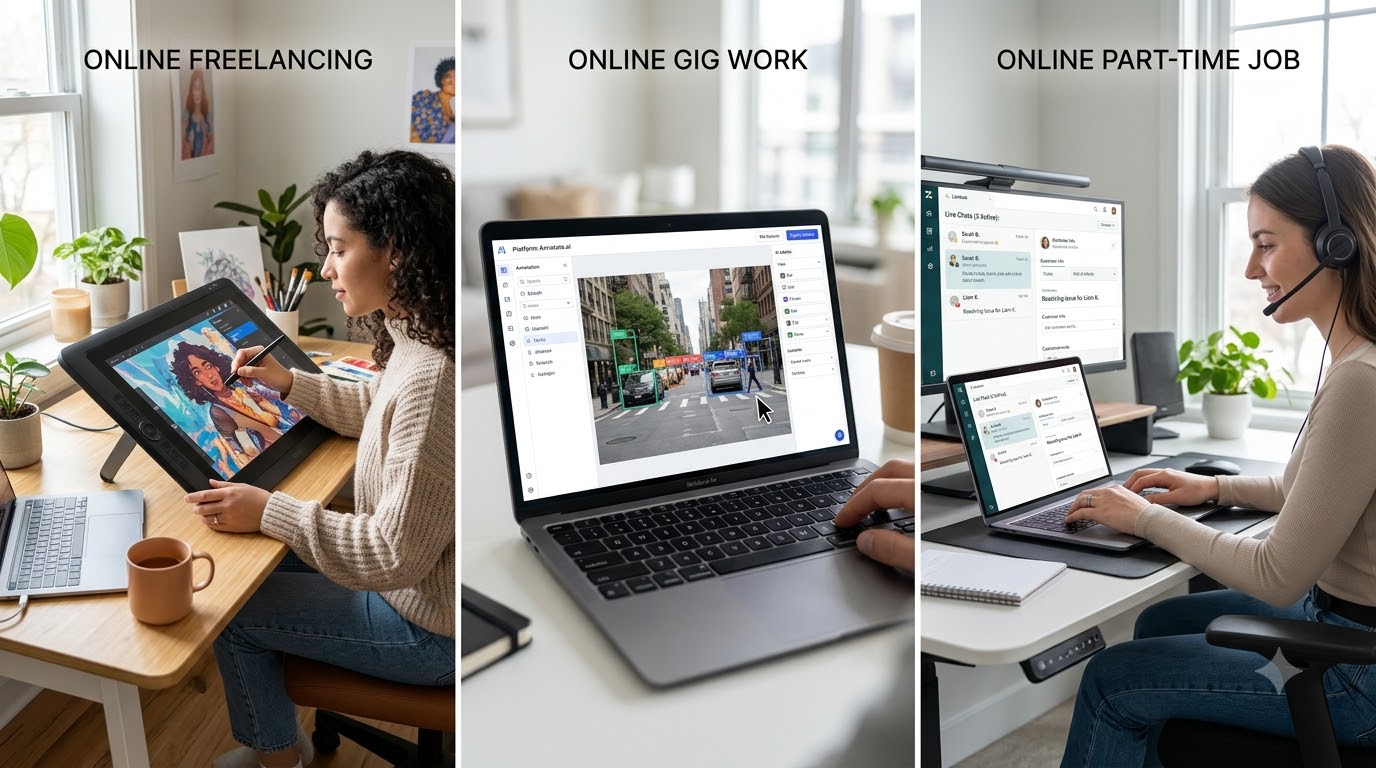
Freelancing vs Gig Work vs Part-Time Jobs: Which Type of Flexible Work Suits You?
An in-depth comparison of freelancing, gig work, and part-time jobs to help you choose the best fit for your lifestyle.

Business Outreach Jobs: How Local Brand and Merchant Acquisition Gigs Work
A deep dive into business outreach jobs and how you can earn by onboarding local merchants to digital platforms.

Field Gig Jobs in India: Flexible Work Beyond an Office or Laptop
Learn about the growing market for field gig jobs, including local business verification, audits, and mystery shopping.