
What Are Microtasks? How Microtask Work and Earnings Work
Learn what microtasks are, how they work, and how you can use them to earn money online efficiently.
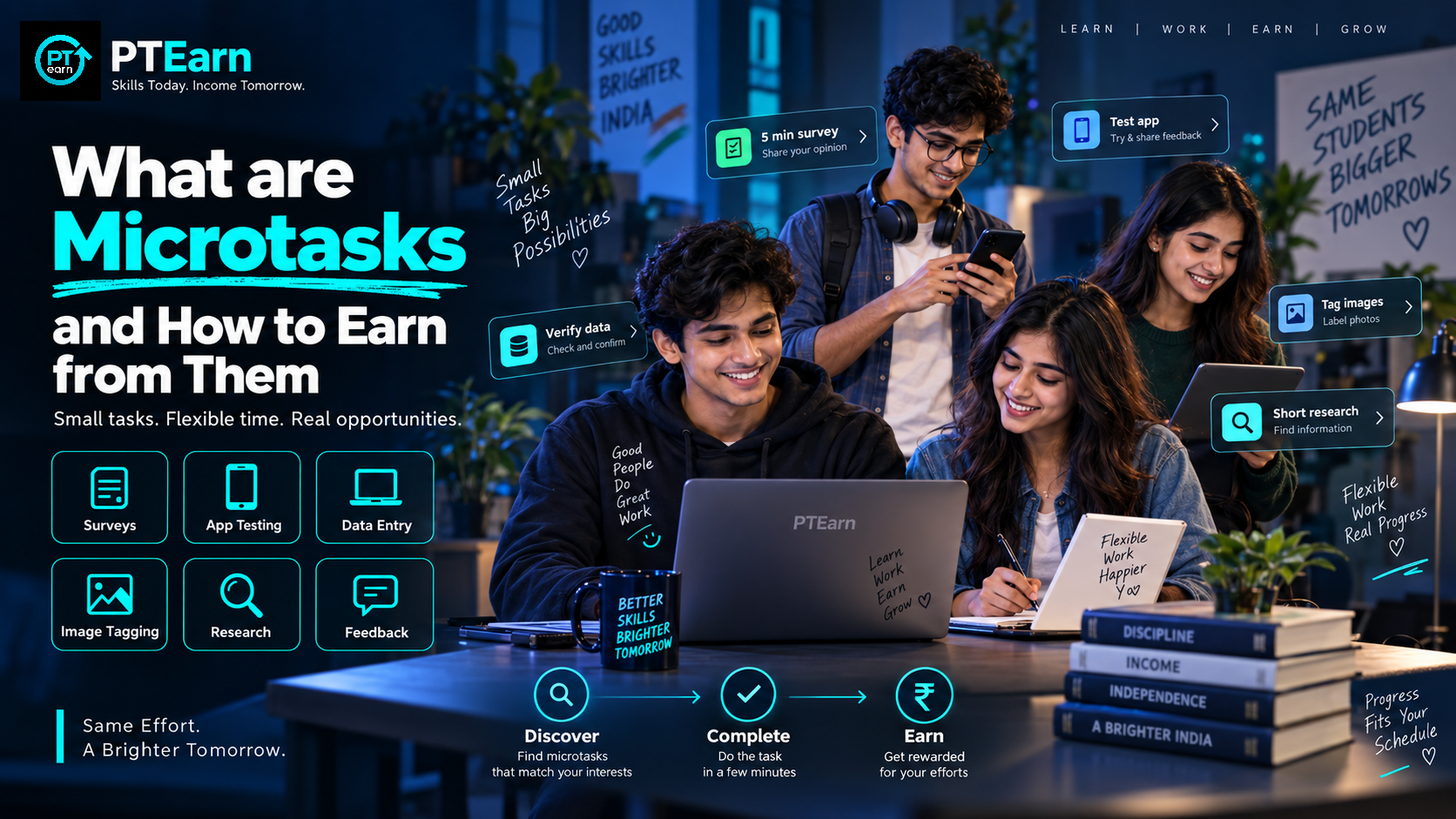
What Are Microtasks? How Microtask Work and Earnings Work
What if you had only 20 minutes free between classes, during a commute, or after dinner?
Traditional part-time work usually expects you to commit to a fixed shift. Freelancing often requires you to find clients, negotiate a project, build a portfolio, and wait for payment. Microtasks work differently.
A microtask is a small, clearly defined piece of work that can usually be completed independently. Instead of being hired for an entire project, you complete one small unit of the project and receive credit or payment for that unit.
Examples include:
- classifying an image,
- checking whether a business address is correct,
- transcribing a short audio clip,
- categorising a product,
- reviewing search results,
- identifying objects in photographs,
- comparing two pieces of text,
- validating data,
- completing short research tasks,
- or answering a market-research questionnaire.
Microtasks can be attractive to students, homemakers, professionals, freelancers, and anyone looking for flexible online work. However, they are not guaranteed quick money. Task availability, eligibility, accuracy requirements, rejection rates, payment policies, and your own speed all affect what you actually earn.
This guide explains how microtask work functions, what businesses use it for, how to calculate your real earnings, and the practical tricks that can help you work more efficiently.
Important: Earnings from microtasks are variable. Treat them as flexible supplementary income unless you have enough consistent data from your own work to prove otherwise.
What Exactly Is a Microtask?
A microtask is a small unit of a larger job or project.
Imagine a company needs to review 500,000 product images. Assigning one employee to manually inspect every image would take an enormous amount of time.
Instead, the company can divide the project into thousands of tiny tasks:
"Does this image contain a shoe? Yes or No."
One worker might review 50 images. Another may review 200. Thousands of workers can contribute to the same larger project.
This approach is often called crowdwork, crowdsourcing, data annotation, or online platform work, depending on the type of task and platform.
The International Labour Organization describes microtask platforms as web-based labour platforms that give businesses access to a flexible workforce for small tasks such as image identification, transcription, annotation, content moderation, data processing and translation.
Microtasks often have four characteristics:
- Small scope — one clear action or decision.
- Short completion time — often seconds or minutes rather than days.
- Standardised instructions — many workers complete similar tasks.
- Per-task or piece-rate payment — earnings are often tied to accepted completed work.
Microtasks vs Freelancing vs Part-Time Jobs
These three types of work are often confused.
| Work Type | Typical Commitment | How You Get Paid | Main Requirement |
|---|---|---|---|
| Microtasks | Seconds to minutes per task | Per task / batch / accepted unit | Accuracy and speed |
| Freelancing | Hours to weeks per project | Project fee or hourly rate | Skill, client management and delivery |
| Part-time job | Fixed or scheduled shifts | Hourly, daily or monthly | Regular availability |
A freelance graphic designer may be paid to design an entire campaign.
A microtask worker may instead be asked to look at 100 generated ad images and mark which ones contain unreadable text.
The difference is important because microtask income should be measured differently. The amount shown for one task does not tell you how profitable it is.
Why Do Companies Need Microtask Workers?
Modern businesses collect enormous amounts of images, video, audio, text, product data, customer feedback and location information.
Computers are excellent at processing data, but many projects still require human judgement.
For example, a machine-learning team may need humans to answer questions such as:
- Is this photograph showing a car, bicycle or bus?
- Is this customer comment positive, negative or neutral?
- Did the speech-to-text system transcribe this sentence correctly?
- Does this search result match the user's query?
- Is this local shop still operating?
- Does this product belong under men's shoes or women's shoes?
- Is the generated AI response factually supported by the supplied information?
A business may have millions of such decisions to make. Microtask platforms make it possible to divide that workload among a large pool of workers.
Microtasks and the Growth of the Gig Economy
Microtasks form only one part of the wider gig and platform economy.
NITI Aayog estimated that India had approximately 7.7 million gig workers in 2020–21 and projected the gig workforce could grow to around 23.5 million by 2029–30. This includes many kinds of gig work—not only online microtasks.
Globally, the World Bank's Working Without Borders research identified 545 online gig-work platforms across 186 countries in its broader study of online platform work.
These figures show how large flexible digital work has become, but they should not be misread as the number of microtask workers specifically. The International Labour Organization has also warned that measurement gaps make the total number of digital-platform workers difficult to estimate precisely.
The practical takeaway is simple:
Online task-based work is a real and growing category of work, but exact market-size claims should be treated carefully.
Common Types of Microtasks
1. Image Annotation
Image annotation is widely used in artificial-intelligence and computer-vision projects.
Tasks may include:
- drawing a box around a vehicle,
- marking pedestrians,
- identifying damaged products,
- classifying clothing,
- marking road signs,
- identifying food items,
- or selecting whether two images show the same object.
Tip
Read the annotation rules before doing the first batch. A task that appears obvious may require precise rules about shadows, partially visible objects, reflections or overlapping objects.
Accuracy is usually more valuable than finishing the first few tasks extremely quickly.
2. Text Classification
You may be shown a short sentence, review, comment or message and asked to place it into a category.
Examples:
- positive / neutral / negative,
- complaint / enquiry / compliment,
- spam / not spam,
- relevant / irrelevant,
- abusive / non-abusive,
- purchase intent / no purchase intent.
Tip
Do not classify based only on one keyword.
For example:
"The delivery was late, but customer support solved the issue immediately."
This sentence contains both negative and positive signals. The task instructions determine the correct label.
3. Audio Transcription
A worker listens to audio and types what was spoken.
Tasks can involve:
- short voice commands,
- customer-service calls,
- interviews,
- regional accents,
- noisy recordings,
- or speech samples for AI training.
Tip
Use good headphones, work in a quiet location, and learn the platform's rules for punctuation, filler words and unclear speech.
A transcription task can become unprofitable if you repeatedly replay the same audio.
4. Audio Validation
Instead of typing the audio, you may only need to confirm whether an existing transcription is correct.
For example:
Audio: "Turn on the bedroom light."
Text: "Turn on the bedroom lights."
Your job may be to mark the transcription as correct or incorrect.
These tasks can often be completed faster than full transcription.
5. Data Entry and Data Validation
Businesses constantly need structured and accurate data.
Possible microtasks include:
- copying invoice fields,
- checking phone numbers,
- categorising products,
- verifying postal codes,
- comparing two database records,
- extracting dates,
- checking duplicate entries,
- validating website information.
Tip
Do not assume that copying quickly means earning more. One wrong digit can make the complete task invalid.
6. Local Business Verification
Some microtasks combine online instructions with offline activity.
A task may ask you to confirm:
- whether a shop exists,
- opening hours,
- business category,
- storefront photograph,
- accessibility,
- product availability,
- or whether the business has permanently closed.
These are often called field microtasks, verification gigs, or local data-collection tasks.
Safety Tip
Never enter a restricted area or misrepresent yourself. Follow the client's instructions, respect photography rules and avoid collecting sensitive personal information unless the task clearly and legally requires it.
7. Search-Relevance Evaluation
Search engines, marketplaces and AI systems need humans to judge whether results are useful.
Example:
Search query: "running shoes for women"
Result: men's formal leather shoes
You might rate the result as irrelevant.
These tasks require concentration because subtle differences in user intent can change the correct rating.
8. AI Response Evaluation
As generative AI becomes more common, humans are also needed to evaluate outputs.
Tasks may ask:
- Which of two AI answers is more useful?
- Does the answer follow the instructions?
- Is the response factually supported by the supplied source?
- Is the response safe?
- Is the writing grammatically correct?
- Does the answer contain irrelevant information?
This category may require stronger language, reasoning, coding or subject-matter skills than basic microtasks.
9. Surveys and Market Research
Short questionnaires can also fall under the microtask model.
Companies may pay participants to provide opinions about:
- advertisements,
- products,
- services,
- pricing,
- brand awareness,
- shopping habits,
- apps,
- entertainment,
- or consumer behaviour.
You will not qualify for every survey because researchers often need a specific demographic.
Tip
Complete demographic profiles truthfully. Giving inconsistent information may reduce future survey eligibility or lead to account restrictions.
10. Website and App Testing
Short usability tests may involve:
- opening a website,
- completing a specific action,
- recording what confused you,
- reporting a bug,
- or rating the experience.
These tasks may pay differently from simple click-based microtasks because they require more time and detailed feedback.
How Microtask Earnings Actually Work
A common beginner mistake is looking only at the payment per task.
Suppose Task A pays ₹5.
That tells you almost nothing until you know:
- how long the task takes,
- how often tasks are available,
- whether qualification time is unpaid,
- what percentage of your work is accepted,
- whether there is a withdrawal minimum,
- and whether payment or currency-conversion fees apply.
The number you should care about is your effective hourly earning rate.
Simple Formula
Effective Hourly Rate =
Accepted Earnings ÷ Total Time Spent × 60
If you earn ₹80 from accepted work and spend 40 minutes in total:
₹80 ÷ 40 × 60 = ₹120 per hour
But "total time" should include:
- searching for available work,
- reading instructions,
- qualification tests,
- completing tasks,
- fixing errors,
- waiting for pages,
- and rejected work that produced no payment.
This is important because research on online platform work has repeatedly found that unpaid time spent looking for tasks can reduce workers' real effective earnings.
A Better Way to Compare Microtasks
Imagine two tasks.
Task A
- Payment: ₹2
- Completion time: 20 seconds
- Availability: inconsistent
- Rejection risk: high
Task B
- Payment: ₹15
- Completion time: 4 minutes
- Availability: consistent
- Rejection risk: low
Task A appears tiny, but if you could continuously complete accepted tasks at 20 seconds each, its theoretical rate would be high.
The problem is that real work rarely runs continuously.
You may spend several minutes refreshing, checking instructions or waiting for new tasks.
That is why task value must be compared using your real timer, not the platform's headline price.
Illustrative Earnings Scenarios
The following examples are calculations, not promises or market rates.
| Scenario | Accepted Tasks | Average Pay | Earnings |
|---|---|---|---|
| Small session | 10 | ₹3 | ₹30 |
| Focused batch | 25 | ₹5 | ₹125 |
| Higher-value batch | 10 | ₹20 | ₹200 |
| Mixed session | Various | — | Depends on accepted work |
Now include time.
If the ₹125 batch takes:
- 30 minutes → effective rate = ₹250/hour
- 60 minutes → effective rate = ₹125/hour
- 90 minutes → effective rate ≈ ₹83/hour
Same tasks. Same payment. Very different efficiency.
This is why experienced microtask workers think in terms of earnings per minute, not just earnings per task.
The 60-Second Task Test
Before committing to a large batch, complete a few tasks and calculate:
Expected Hourly Rate =
Average Accepted Pay per Task
÷ Average Minutes per Task
× 60
For example:
₹4 ÷ 2 minutes × 60 = ₹120/hour
Then reduce the estimate to account for:
- downtime,
- rejection risk,
- loading time,
- and breaks.
This simple habit can prevent you from spending an hour on low-value work without realising it.
The Most Important Microtask Metric: Acceptance Rate
Many platforms use quality controls.
A business does not want 10,000 fast answers if 3,000 are wrong.
Quality mechanisms can include:
- qualification tests,
- hidden test questions,
- peer review,
- majority voting,
- random audits,
- historical performance scores,
- or manual review.
Some crowdsourcing systems assign future work based partly on a worker's qualifications and previous performance.
That makes your accuracy history an economic asset.
A worker who rushes through tasks may earn slightly more for 30 minutes but lose access to better tasks later.
Tips and Tricks to Earn More Efficiently
1. Track Every Work Session
Create a simple spreadsheet with these columns:
| Date | Task Type | Minutes | Submitted | Accepted | Earnings | Effective ₹/Hour |
|---|
After a week, patterns become obvious.
You may discover that:
- transcription pays better than surveys,
- image tasks are faster in the morning,
- one platform has too much unpaid waiting,
- or a task category produces too many rejections.
Data helps you stop guessing.
2. Create a Personal Minimum Rate
After tracking your results, decide what effective rate makes a task worthwhile for you.
For example:
"I will avoid task categories that consistently produce less than my chosen minimum effective rate."
Your threshold is personal. A student using otherwise-unused time may make a different decision from a professional giving up paid freelance hours.
3. Do a Five-Task Trial Before a Large Batch
Never assume the first task represents the whole batch.
Complete approximately five tasks and check:
- average time,
- difficulty,
- instruction clarity,
- loading speed,
- likely error rate,
- and payment.
Then decide whether to continue.
4. Read the Instructions Twice
This sounds slow, but it can save money.
Microtask instructions often contain special rules such as:
- ignore advertisements,
- choose only one label,
- mark partially visible objects,
- include punctuation,
- do not correct spelling,
- use a specific date format.
One misunderstanding can affect an entire batch.
5. Build Specialisation
Do not try to become equally good at every microtask.
You may naturally be faster at:
- English-language evaluation,
- product categorisation,
- image annotation,
- Excel/data work,
- coding evaluation,
- regional-language transcription,
- research,
- or local business verification.
Specialisation can improve both speed and accuracy.
6. Learn Keyboard Shortcuts
When the platform allows them, shortcuts can save several seconds per task.
If a task takes 30 seconds and you reduce it to 25 seconds without lowering quality, that is a 16.7% reduction in task time.
Across hundreds of tasks, small improvements matter.
Do not use automation, scripts or bots unless the platform explicitly permits them.
7. Avoid Multitasking
Watching a video while classifying data may feel efficient, but microtasks often depend on small details.
Poor concentration can increase:
- mistakes,
- rejections,
- qualification failures,
- and account-quality problems.
Use focused 20–30 minute work blocks instead.
8. Work When Good Tasks Appear
Microtask availability can be irregular.
The ILO has documented task availability as a major challenge in crowdwork. In one study, many workers wanted more work than platforms were able to provide consistently.
Therefore, flexibility has two sides:
You may be free to choose when to work, but the best-paying tasks may not always be available when you log in.
Keep multiple legitimate earning options rather than relying entirely on one source.
9. Do Not Chase a Sunk Cost
Suppose you spend 15 minutes learning a task and realise it pays poorly.
A common reaction is:
"I've already spent 15 minutes, so I should keep going."
That can turn 15 unproductive minutes into two unproductive hours.
Recalculate the expected rate after the learning period. Stop if the task no longer makes sense.
10. Protect Your Quality Score
If you are tired, distracted or unsure about the instructions, stop.
A temporary drop in today's earnings may be better than creating a history of poor-quality work.
A 30-Minute Beginner Microtask Routine
If you have only 30 minutes, use a structured session.
Minutes 0–3: Check Opportunities
Look for tasks that match skills you already understand.
Avoid spending half the session opening random tasks.
Minutes 3–8: Read and Test
Read the instructions and complete a small sample.
Minutes 8–25: Focused Batch
Work without switching between apps or categories.
Minutes 25–28: Check Quality
Review mistakes, rejections or feedback if available.
Minutes 28–30: Record Results
Write down:
- total time,
- accepted earnings,
- task type,
- and effective hourly rate.
After several sessions, you will know which tasks deserve your time.
How to Find Microtask Opportunities on PTEarn
When microtask opportunities are available on PTEarn, evaluate them in the same disciplined way you would evaluate any flexible job.
Look for information such as:
- task description,
- required skill,
- eligibility,
- estimated effort,
- payment or reward structure,
- location requirements,
- deadline,
- proof required,
- and the identity of the business or task provider where available.
Do not apply blindly to every opportunity.
A better strategy is to create a small "task portfolio":
Category A: Quick Tasks
Tasks you can complete from your phone during small pockets of free time.
Examples:
- surveys,
- simple validation,
- categorisation.
Category B: Focus Tasks
Tasks that need 20–60 minutes of concentration.
Examples:
- transcription,
- data annotation,
- research,
- app testing.
Category C: Local Tasks
Tasks that require you to visit a location.
Examples:
- store verification,
- field audits,
- photographs,
- availability checks.
This makes it easier to choose work based on how much time you currently have.
Smartphone vs Laptop: Which Is Better?
A smartphone works well for:
- short surveys,
- photographs,
- local verification,
- simple classifications,
- location-based tasks.
A laptop is usually better for:
- transcription,
- spreadsheets,
- data entry,
- long text,
- multi-window research,
- detailed AI evaluation.
Your device affects your speed, which affects your real hourly earnings.
Internet and Equipment Checklist
You do not need an expensive workstation for most microtasks, but reliability matters.
A basic setup may include:
- stable internet,
- updated browser,
- smartphone,
- laptop or desktop where required,
- headphones for audio tasks,
- quiet work environment,
- password manager,
- spreadsheet for earning records.
For field tasks, make sure your phone has:
- adequate battery,
- working camera,
- sufficient storage,
- mobile data,
- and location permissions only when genuinely required.
How to Identify a Fake Microtask Job
Where flexible earning opportunities exist, scams follow.
Be suspicious when someone promises:
- guaranteed large daily income for simple clicking,
- payment only after a "registration fee",
- a compulsory security deposit,
- payment for unlocking tasks,
- a requirement to send money before withdrawal,
- guaranteed returns,
- or unusually high income with no skill, effort or risk explanation.
Red Flag: Pay Money to Get Paid
Legitimate work may have platform fees deducted from earnings in some business models, but a stranger asking you to transfer money personally to "activate" a job is a serious warning sign.
Red Flag: Sensitive Credentials
Never share:
- UPI PIN,
- ATM PIN,
- card CVV,
- net-banking password,
- OTP,
- or screen-sharing access to your banking app.
Receiving a payment does not require revealing your UPI PIN.
Red Flag: Unknown APK Files
Do not install random Android APK files sent over WhatsApp or Telegram simply because someone claims they are required for a task.
Use official app stores or verified company websites.
Red Flag: Unrealistic Income Claims
If a task claims:
"Earn ₹5,000 every day by clicking ten buttons"
ask where the economic value comes from.
A genuine business pays because the work produces useful value. If the value is impossible to explain, be cautious.
Do Microtasks Require Experience?
Many basic tasks do not require formal work experience.
However, that does not mean they require no skill.
Useful skills include:
- reading carefully,
- basic English or regional-language ability,
- typing,
- attention to detail,
- internet research,
- spreadsheet basics,
- visual observation,
- consistency.
Higher-value task categories may require:
- programming,
- mathematics,
- finance,
- legal knowledge,
- medical knowledge,
- multilingual ability,
- advanced writing,
- or domain expertise.
A practical strategy is to start simple and gradually qualify for more specialised work.
Can Students Do Microtasks?
Yes, task-based work can suit students because many tasks can be completed without a fixed shift.
However:
- academics should remain the priority,
- income is not guaranteed,
- some platforms may have minimum-age requirements,
- identity verification may be required,
- and you must follow each platform's terms.
A student with 30–60 minutes of spare time may benefit more from building a useful skill while doing microtasks than from maximising short-term income alone.
For example, data annotation can introduce you to AI datasets, while usability testing can improve your understanding of product design.
Are Microtasks a Full-Time Career?
For most beginners, microtasks are better viewed as supplementary flexible work.
The ILO's research into web-based platform work has highlighted several recurring challenges:
- irregular task availability,
- unpaid time spent searching for work,
- low effective earnings for some workers,
- and limited social protection for independent platform workers.
That does not make microtasks useless.
It means you should use them strategically.
A healthy progression can look like:
Microtasks
   ↓
Discover a skill you perform well
   ↓
Build experience
   ↓
Take higher-value specialised tasks
   ↓
Freelance / part-time skilled work
   ↓
Longer-term career opportunities
For example:
- basic transcription → professional transcription,
- image tagging → data annotation / AI operations,
- website testing → QA testing,
- product categorisation → e-commerce operations,
- local verification → field auditing,
- research microtasks → virtual assistance or market research.
Seven-Day Microtask Experiment
Instead of asking, "How much can I earn from microtasks?", run your own experiment.
Day 1: Explore
Identify three legitimate task categories.
Day 2: Test
Spend 20–30 minutes on each category.
Day 3: Measure
Calculate effective hourly earnings.
Day 4: Improve
Learn shortcuts and review errors.
Day 5: Specialise
Focus only on your best-performing category.
Day 6: Compare
Compare earnings, difficulty and enjoyment.
Day 7: Decide
Choose one of three outcomes:
- continue,
- use microtasks only occasionally,
- move your time into a higher-value skill.
This gives you a decision based on real personal data rather than internet income claims.
Microtask Earnings Tracker Template
You can copy this into Google Sheets or Excel:
Date:
Platform / Source:
Task Category:
Task Description:
Total Minutes:
Tasks Submitted:
Tasks Accepted:
Tasks Rejected:
Gross Earnings:
Fees:
Net Earnings:
Effective Hourly Rate:
What I Learned:
Would I Do This Task Again? Yes / No
The most important fields are:
Net Earnings
Total Time
Acceptance Rate
Acceptance Rate Formula
Acceptance Rate =
Accepted Tasks ÷ Submitted Tasks × 100
Example:
95 accepted ÷ 100 submitted × 100 = 95%
Tracking this number can reveal whether you are working too quickly.
Frequently Asked Questions
How long does a microtask take?
There is no fixed duration. Some tasks take seconds, while others can take several minutes or longer. Qualification tests and complex evaluation work can take significantly more time.
Can I do microtasks from my phone?
Yes, some task categories are mobile-friendly. Others are significantly easier or only possible on a laptop or desktop.
Is microtask income guaranteed?
No. Earnings depend on task availability, eligibility, quality, speed, payment rates, platform rules and acceptance.
Can my work be rejected?
Depending on the platform and task, yes. Always understand the review and rejection policy before committing substantial time.
Is microtask work the same as data entry?
Data entry can be a microtask, but microtasks include many other categories such as image labelling, transcription, surveys, content evaluation and AI training.
Are microtasks only for AI companies?
No. AI companies use microtasks heavily, but e-commerce, research, mapping, advertising, search, media, retail and other industries also use task-based work.
Do I need to pay tax on microtask earnings in India?
Income can have tax implications depending on your total income, the nature of the work and your circumstances. Keep records of earnings and expenses, and consult a qualified tax professional when needed.
Final Takeaway
Microtasks are one of the most flexible forms of digital work.
You may be able to open a platform, complete a few pieces of work, and stop without committing to a shift or long-term contract.
But flexibility does not automatically mean high earnings.
Successful microtask workers focus on four things:
- Accuracy
- Effective hourly earnings
- Task availability
- Skill progression
Do not ask only:
"How much does this task pay?"
Ask:
"How much accepted income can I earn for every hour of my real time?"
That one question can completely change the way you choose microtasks.
Use small tasks to earn, experiment and learn—but keep improving your skills so your time becomes more valuable over the long term.
Sources and Further Reading
The facts and industry context in this article were informed by the following sources:
International Labour Organization — Digital labour platforms and the future of work
https://www.ilo.org/publications/digital-labour-platforms-and-future-work-towards-decent-work-online-worldInternational Labour Organization — Digital labour platforms: Number of platforms and workers (2026)
https://www.ilo.org/publications/digital-labour-platforms-number-platforms-and-workersWorld Bank — Working Without Borders: The Promise and Peril of Online Gig Work
https://www.worldbank.org/en/news/press-release/2023/09/07/demand-for-online-gig-work-rapidly-rising-in-developing-countriesNITI Aayog — India's Booming Gig and Platform Economy
https://www.niti.gov.in/node/375Clickworker — How crowdsourced projects are broken into microtasks and quality-controlled
https://www.clickworker.com/how-it-works/
PTEarn educational content is intended to help readers understand flexible-work opportunities. Availability and earnings vary by platform, task, skill, location and time. Never pay an unknown recruiter to unlock a job, and always verify the terms of any opportunity before sharing personal information or starting work.
Looking for flexible earning opportunities?
Explore part-time jobs and microtasks available on PTEarn.
Keep Reading

App Testing Jobs in India: How Paid User Testing Works
Discover how you can earn money by testing new apps, reporting bugs, and providing usability feedback.

Online Survey Jobs in India: How Paid Surveys Really Work
A realistic guide to online surveys in India, including how to qualify and how to avoid fake survey scams.

15 Best Part-Time Jobs for Students in India in 2026
Explore 15 practical part-time jobs for students in India in 2026, including microtasks, tutoring, app testing, digital marketing, customer support and local gig work.