
15 Best Part-Time Jobs for Students in India in 2026
Explore 15 practical part-time jobs for students in India in 2026, including microtasks, tutoring, app testing, digital marketing, customer support and local gig work.
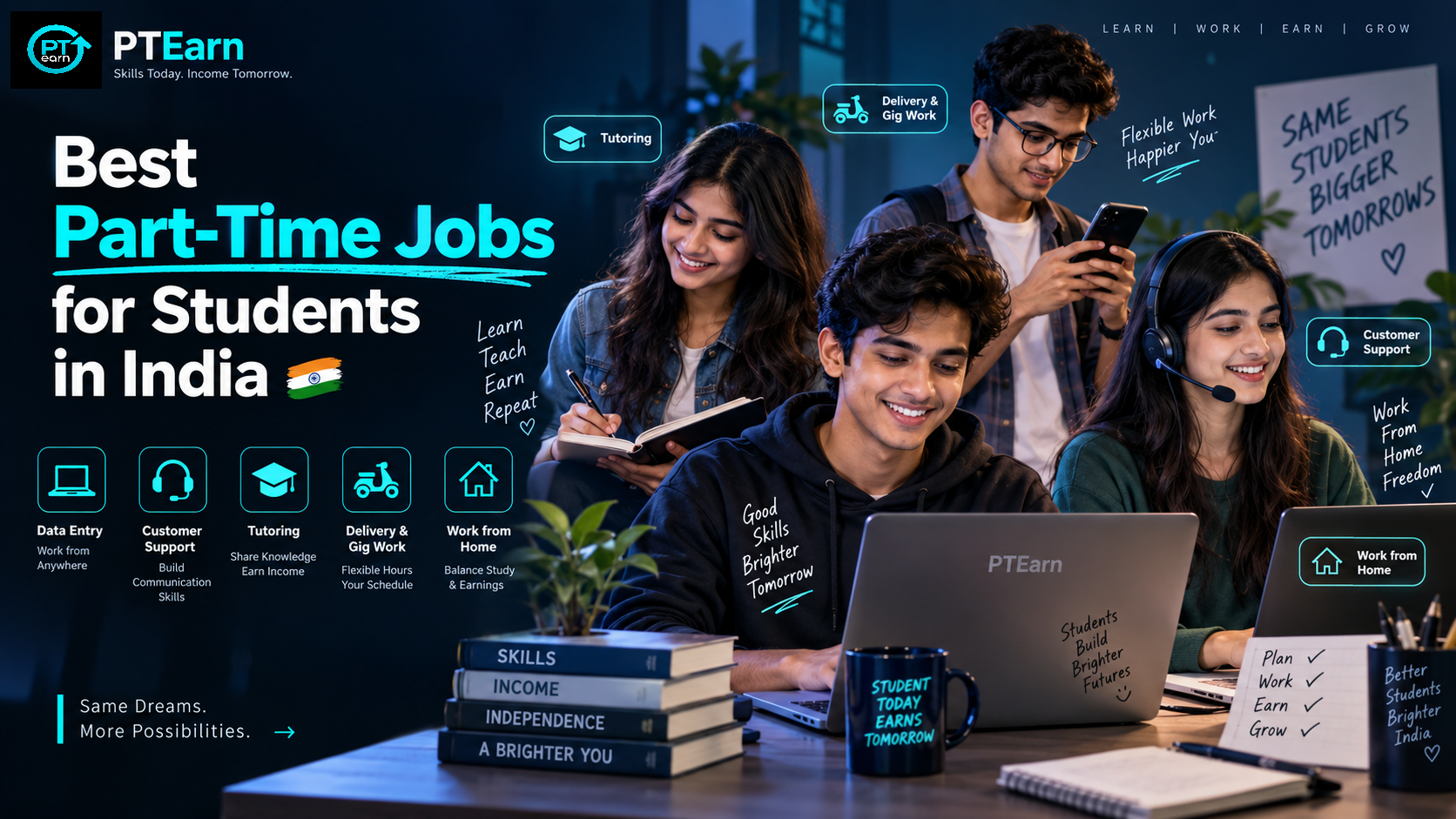
15 Best Part-Time Jobs for Students in India in 2026
College is not only a time to earn a degree. It is also a good time to learn how work actually happens: dealing with deadlines, communicating with customers, solving problems, working with a team and managing money.
The challenge is finding work that fits around classes instead of competing with them.
India has nearly 4.46 crore students enrolled in higher education, according to the Ministry of Education's latest completed AISHE survey. At the same time, flexible, platform-based and short-term work is becoming a larger part of India's employment landscape.
NITI Aayog's 2026 report Reimagining Skilling for Viksit Bharat@2047 goes a step further. It proposes a concept called FlexEarn, aimed at helping final-year college students and recent graduates discover part-time opportunities while continuing to build workplace skills.
For students, this is the important idea:
A good part-time job should give you more than money. It should give you flexibility, experience, skills or useful professional connections — preferably more than one of these.
This guide looks at 15 practical types of part-time work students in India can explore in 2026.
Important: Job and task availability varies by city, skill, age, schedule and employer requirements. Earnings are never guaranteed. Always verify an opportunity before sharing personal information or starting work.
Quick Comparison: Which Part-Time Job May Suit You?
| Part-Time Work | Where You Work | Flexibility | Good Starting Skill | Common Payment Model |
|---|---|---|---|---|
| Microtasks | Remote | Very high | Basic digital skills | Per task |
| Online tutoring | Remote/local | High | Subject knowledge | Hourly/session |
| Content writing | Remote | High | Writing | Article/project |
| Customer support | Remote/office | Medium | Communication | Hourly/monthly |
| Data entry & verification | Remote/office | High | Accuracy | Task/hour/month |
| App & website testing | Remote | High | Observation | Test/task |
| Social media assistance | Remote/local | High | Social media basics | Monthly/project |
| Digital marketing | Remote/local | Medium-high | Basic marketing | Project/month |
| Design & video editing | Remote | High | Creative software | Project |
| Campus ambassador | Campus/hybrid | High | Communication | Stipend/incentive |
| Research assistance | Remote/college | High | Research | Project/hour |
| Business outreach | Local/hybrid | High | Communication | Hour/stipend/incentive |
| Retail & event work | Local | Medium | People skills | Shift/day |
| Delivery & field gigs | Local | High | Navigation | Task/delivery |
| UGC creation | Remote/local | High | Content creation | Content/project |
1. Microtasks
Microtasks are small pieces of work that are divided into short, clearly defined activities.
Instead of committing to a four-hour shift, you may be able to complete a task in 5, 10 or 30 minutes.
Examples include verifying information, categorising images, completing eligible surveys, reviewing search results, performing simple online research, testing a small feature or checking whether data is correct.
Why microtasks can suit students
The biggest advantage is flexibility. If your college timetable changes regularly, fixed shifts can be difficult. Microtasks can sometimes be completed between classes, in the evening or during other free periods.
They can also introduce students to task-based work where payment is connected to a specific completed activity rather than attendance.
What you need
Usually, the most important qualities are accuracy, the ability to follow instructions and basic digital skills.
You do not necessarily need professional experience for beginner-level tasks.
What to watch for
Not every task will be available to every person. Some tasks have demographic, language, device or location requirements.
Do not treat microtasks as guaranteed daily income.
Learn more in our guide to what microtasks are and how they work.
2. Online Tutoring
If you understand a subject well, tutoring is one of the most natural student jobs.
A B.Tech student may tutor school students in mathematics. A commerce student may teach accountancy. Someone with excellent spoken English may help learners practise communication.
Tutoring can happen online through video calls or locally in your neighbourhood.
Why it works well for students
You are earning from knowledge you already have while strengthening your own fundamentals.
Teaching also develops communication, patience and presentation skills — abilities that remain useful even if you never become a teacher.
Best suited for
Students who have strong knowledge in a particular subject and can explain concepts clearly.
The difficult part is not knowing the answer yourself. It is being able to help someone else understand it.
3. Content Writing and Proofreading
Businesses constantly need words: blog articles, product descriptions, email copy, social posts, website pages, documentation and marketing material.
Students with strong English, Hindi or regional-language skills can start with relatively small assignments.
But good content writing is not simply typing words quickly.
You may need to understand a brief, research a topic, organise information, fact-check claims and write for a particular audience.
A practical way to start
Instead of saying:
"I am a content writer."
Build three samples.
For example, write a 700-word educational article, one product description and five social-media posts.
A small portfolio is much more convincing than simply claiming you can write.
AI changes the job — it does not necessarily remove it
In 2026, basic text generation is easy.
The valuable skills increasingly become research, fact checking, editing, subject knowledge, original examples, interviewing and judgement.
Students who learn those skills can offer more value than someone who only generates text.
4. Customer Support and Chat Support
Customer-support work can include answering questions over phone calls, email, chat or WhatsApp.
Businesses may need support during evenings, weekends or peak periods, which can sometimes work well with college schedules.
What the work actually involves
You might answer questions about an order, explain how a service works, help a customer complete a process, record complaints or escalate an issue to another team.
Skills that matter
Good communication matters more than complicated technical knowledge for many entry-level roles.
You should be able to listen carefully, remain polite when someone is frustrated, write clearly and follow a defined process.
One limitation
Customer support is usually less flexible than microtasks.
If your shift is 6 PM to 10 PM, the employer normally expects you to be available for that complete period.
Choose it only if your academic timetable is predictable enough.
5. Data Entry and Data Verification
"Data entry" is often misunderstood.
Real data work can involve transferring information from forms into spreadsheets, updating product catalogues, checking customer records, verifying addresses, correcting formatting or comparing information between two systems.
Why students can start here
Advanced qualifications are often less important than accuracy.
Basic spreadsheet knowledge can make a significant difference.
Learn how to use filters, sorting, keyboard shortcuts, basic formulas and clean data-entry practices.
Important warning
"Online data entry job" is also a phrase frequently used by scammers.
A legitimate opportunity should clearly explain the work, payment method and employer.
Be extremely cautious if someone promises unusually high earnings for simple typing and first asks you to pay a registration, software or security fee.
6. App and Website Testing
Companies need real people to use their products before and after launch.
You may be asked to complete actions in an app or website and report what happened.
For example:
Create an account → find a product → complete a specific action → report anything confusing or broken.
This is different from professional software testing, which may require deeper technical skills.
What makes someone a good user tester?
Observation.
Instead of writing:
"The app is bad."
Useful feedback would be:
"I expected the Continue button to become active after entering my phone number, but nothing changed and there was no error message."
Specific feedback is valuable.
This type of work can be particularly suitable for students who naturally enjoy trying technology and explaining problems clearly.
7. Social Media Assistant
Thousands of small businesses know they should be active on Instagram, Facebook or other platforms but do not have someone dedicated to managing them.
A student can sometimes help a local shop, trainer, restaurant, salon, coaching centre or small ecommerce business with basic social-media operations.
The work might include preparing posts, scheduling content, replying to basic messages, organising content ideas or creating simple graphics.
Why this is more valuable than simply "using Instagram"
Businesses care about outcomes.
Can you maintain consistency?
Can you write clearly?
Can you respond professionally?
Can you understand what customers are asking?
Those are workplace skills.
A student managing one small business account successfully can later use that experience to win another client.
8. Digital Marketing Assistant
Digital marketing is broader than social-media posting.
Students may assist businesses with activities such as keyword research, basic SEO, email campaigns, Google Business Profile updates, lead organisation, ad-report preparation or competitor research.
Why it is an excellent career-building part-time job
Digital marketing produces measurable work.
You can learn concepts such as:
impressions → clicks → leads → customers
That makes the experience useful for careers in marketing, ecommerce, product management, sales and entrepreneurship.
You do not need to learn everything at once.
Start with one area, such as local SEO, content marketing or social-media marketing, and gradually expand your skills.
9. Graphic Design and Short-Video Editing
Businesses need posters, social-media creatives, product images, presentations and short videos.
Tools such as Canva and modern mobile/video editors have lowered the technical barrier to getting started.
But knowing a tool is different from knowing design.
What clients actually value
They care whether the final result communicates clearly and looks appropriate for their audience.
A student who creates ten polished sample designs for imaginary businesses can build a portfolio before finding the first paying client.
Video editing is especially useful because businesses increasingly need short-form content for social media.
Start small: trimming footage, captions, transitions, resizing and simple promotional clips.
10. Campus Ambassador
Campus ambassador programmes are designed specifically around student networks.
A company may ask representatives to promote an event, introduce a product, collect registrations, organise a campus activity or communicate with student communities.
What you gain beyond compensation
This role can teach:
communication, networking, event coordination, persuasion and reporting.
Those are valuable skills for future sales, marketing and management roles.
Look beyond the title
Some "campus ambassador" programmes are essentially referral schemes.
Before joining, understand what work is actually expected and how compensation is calculated.
A genuine professional programme should be able to explain both.
11. Online Research and Research Assistance
Research work is one of the most overlooked student gigs.
Businesses, professors, consultants, content teams and startups often need information collected and organised.
A task could involve finding publicly available information about companies, comparing products, checking public databases, collecting market information or summarising sources.
The skill that makes research valuable
Anyone can search Google.
The professional skill is:
finding the right information, validating it and presenting it in a usable format.
Students who learn spreadsheets, source evaluation and structured note-taking can become surprisingly useful to small teams.
Never collect or scrape information in ways that violate privacy, laws or website/platform rules.
12. Business Outreach and Lead Generation
This is a useful option for students who are comfortable talking to people.
A local business outreach associate might contact shops, offices, restaurants, coaching centres or other businesses and explain a company's service.
The person may identify interested businesses, collect basic requirements and send qualified leads back to the company.
Why it is valuable experience
You learn quickly how businesses make decisions.
You also develop communication, confidence, sales understanding and local-market knowledge.
For students considering careers in sales, business development, marketing or entrepreneurship, this can provide more real-world exposure than many classroom exercises.
Some roles are phone-based, while others require field visits. Always confirm this before accepting the work.
13. Retail, Event and Promotional Work
Part-time work does not need to happen online.
Retail stores, exhibitions, conferences, promotions and events sometimes need additional staff during busy periods.
Students may help with visitor registration, customer assistance, product demonstration, stall management or event operations.
Who this suits
This type of work is useful for students who prefer interacting with people rather than sitting in front of a laptop.
Weekend events can also fit college schedules better than weekday employment.
The disadvantage is that local travel and fixed working hours are usually required.
14. Delivery and Other Field Gig Work
Location-based gig platforms have made delivery and other field-based work much more visible in India.
NITI Aayog estimated that India had around 77 lakh gig workers in 2020–21 and projected the gig workforce could reach about 2.35 crore by 2029–30.
That is a projection rather than a current headcount, but it illustrates how significantly flexible and platform-based work may grow.
Field gigs can include delivery, local verification, photography, merchant onboarding, document collection or other location-specific assignments.
Consider the true cost
Do not evaluate a field gig only by the amount paid per task.
Consider fuel, vehicle maintenance, mobile data, travel time, waiting time and safety.
Your net earning after expenses is more important than the headline payment.
15. UGC Creator and Brand Content Work
You do not always need thousands of social-media followers to create content for brands.
UGC — user-generated content — typically involves producing natural-looking photos or videos that a business can use in its marketing.
For example, a brand may need someone to demonstrate a product, record a short explanation or create a simple lifestyle video.
How this differs from being an influencer
An influencer is often paid partly for access to their audience.
A UGC creator is primarily being paid for creating the content itself.
That means students with good presentation, shooting or editing skills may be able to participate even with relatively small personal audiences.
Never create fake reviews or pretend to have purchased or experienced something when you have not. Authenticity matters.
How to Choose the Right Part-Time Job as a Student
Do not begin with:
"Which job pays the most?"
Start with:
"Which job fits the life I actually have?"
A student with unpredictable classes may be better suited to microtasks, writing or design.
Someone who is consistently free after 6 PM may be able to take a customer-support shift.
Someone studying mathematics may have a natural advantage in tutoring.
Someone who wants a marketing career may gain more long-term value from social-media or business-outreach work even if another short-term opportunity initially pays slightly more.
A useful way to judge an opportunity is across four factors:
Time: Can you realistically commit to the schedule?
Skills: Can you already do the work, or can you learn it quickly?
Career value: Will the work give you a portfolio, experience or professional connections?
Net earning: After travel, equipment, platform costs and time, is the work still worth doing?
The best part-time job is often not the one with the biggest headline payment. It is the one that fits your schedule and leaves you better prepared for your next opportunity.
How Many Hours Should a Student Work?
There is no single number that is right for everyone.
Your course difficulty, travel time, exams, health and other responsibilities matter.
Start conservatively.
If a job begins to regularly interfere with classes, assignments, sleep or examination preparation, reconsider the schedule.
A useful principle is:
Your part-time job should work around your education — not force your education to work around the job.
During exams, flexible gigs may make more sense than fixed shifts because you can reduce your workload temporarily.
Skills Worth Learning Before Looking for Part-Time Work
You do not need to become an expert before applying.
A few practical skills can dramatically increase the range of opportunities available to you.
Learn basic spreadsheet usage, professional email writing, document formatting, online research, video-call etiquette and how to explain your work clearly.
Then add one specialised skill.
That might be Canva, video editing, digital marketing, tutoring, Excel, content writing, customer support or another skill related to the type of work you want.
The combination of basic professional skills + one useful specialised skill is much stronger than collecting dozens of certificates without practising anything.
Build Proof of Skill, Not Just a Resume
Students often face the same problem:
"Every job asks for experience, but how do I get experience without a job?"
Create evidence yourself.
A writer can publish three sample articles.
A designer can create ten mock social-media posts.
A video editor can edit sample footage.
A digital marketer can audit a local business's online presence.
A tutor can create a short lesson.
A researcher can produce a sample competitor-analysis spreadsheet.
This gives employers something concrete to evaluate.
Your first portfolio does not require your first client.
Part-Time Job Scams Students Should Know About
Students looking for their first job can be attractive targets for fraudsters because they may not yet know what a normal recruitment process looks like.
India's National Career Service explicitly warns jobseekers against fraudulent recruitment communications and states that jobseekers should not pay fees to employers.
Be especially cautious when you see:
- a registration, security, interview or training fee required before receiving work
- guaranteed high income for extremely simple tasks
- pressure to transfer money immediately
- requests for your OTP, UPI PIN, card PIN or banking password
- recruiters who refuse to identify the employer clearly
- jobs that require you to purchase a product before you can work
- schemes focused mainly on recruiting more people rather than doing genuine work
- requests to create fake reviews, fake accounts or misleading content
If you encounter cyber fraud in India, the national cybercrime helpline is 1930.
PTEarn's principle is simple:
You earn through PTEarn. You don't pay to get work.
Explore our job safety guide before accepting an unfamiliar opportunity.
Where Can Students Find Part-Time Work?
There is no single source that contains every legitimate opportunity.
Students can look at employer career pages, recognised job platforms, government employment services, college placement cells, internships, local businesses and flexible-work platforms.
PTEarn is being built specifically around part-time jobs, flexible work, gig opportunities and microtasks.
You can explore part-time jobs, work-from-home opportunities and microtasks through PTEarn.
If no suitable local opportunity is currently available, create a job alert instead of repeatedly checking the same search.
Can a Part-Time Job Actually Help Your Career?
Yes — but only if you treat the work as experience rather than just a transaction.
A customer-support job teaches communication.
Tutoring teaches explanation and patience.
Business outreach teaches sales.
Digital marketing teaches customer acquisition.
Content writing teaches research and communication.
Microtasks teach attention to detail and instruction-following.
Field gigs teach reliability and local operations.
The job title may be temporary. The skill does not have to be.
This matters because the transition from education to employment is increasingly becoming a skills-first problem.
Frequently Asked Questions
Which part-time job is best for college students in India?
There is no universal best option. Students who need maximum schedule flexibility may prefer microtasks, writing, design, app testing or other project-based work. Students with predictable free hours may consider tutoring, customer support, retail or business outreach.
Can students work from home part-time?
Yes, depending on availability and eligibility. Examples can include content writing, tutoring, customer support, app testing, digital marketing, research, design and some microtasks.
Can a 12th-pass student do part-time work?
Many entry-level roles focus more on skills and reliability than degrees. Eligibility still depends on the employer, age requirements and the type of work.
Can students work after 7 PM?
Some customer-support, tutoring, retail, remote, gig and project-based opportunities may operate during evening hours. Students should consider travel and personal safety for late local work.
Are online part-time jobs safe?
Some are legitimate and some are not. Verify the employer, understand the work before starting, never share security credentials, and be suspicious of anyone demanding payment just to provide a job.
Do students have to pay to find a part-time job?
A legitimate employer should not require you to pay a fee merely to receive a job or interview.
Do part-time jobs guarantee a fixed monthly income?
No. Some jobs provide fixed shifts or stipends, while gig and task-based opportunities may vary significantly based on availability, eligibility and completed work.
Final Thoughts
The best reason to start part-time work while studying is not simply to earn your first ₹500 or ₹5,000.
It is to begin understanding how your time and skills create value.
Start small.
Choose work that fits around your studies. Build one skill. Complete real work. Keep evidence of what you have done. Improve your communication. Learn how professional relationships work.
Over time, those experiences become much more valuable than simply writing "fresher" on a resume.
Part-time work should not distract you from building your future.
Done well, it can become part of how you build it.
Looking for flexible opportunities?
Explore part-time jobs near you, discover microtasks, or use PTEarn to find work that fits your available time.
Looking for flexible earning opportunities?
Explore part-time jobs and microtasks available on PTEarn.
Keep Reading

Weekend Part-Time Jobs in India: Flexible Work for Saturdays and Sundays
Discover the most profitable weekend part-time jobs in India for those with packed weekday schedules.

Evening Part-Time Jobs in India: Flexible Work After College or Office Hours
Explore the best evening part-time jobs designed for students and professionals looking to earn extra income after 7 PM.
What Are Microtasks? How Microtask Work and Earnings Work
Learn what microtasks are, how they work, and how you can use them to earn money online efficiently.